
Rugby union betting in New Zealand — the markets, the monopoly and the margin
 Available in US

Data current as of October 30, 2026; cross-checked against the Racing Industry Act 2020 (as amended in 2025) and the Department of Internal Affairs guidance on the betting prohibition.
Rugby union sits at the centre of New Zealand sporting life. The All Blacks have won the Rugby World Cup three times, the sport is the country’s winter conversation, and Super Rugby Pacific fills stadiums from Dunedin to Hamilton every Friday night. A punter scanning a betting app in 2026 is not short of matches to bet on. What is short is the choice of who to bet with. Since 28 June 2025 a single piece of legislation — section 74AAA of the Racing Industry Act 2020 — has meant that only TAB NZ, operating through its two online brands TAB and Betcha, may lawfully take sports and racing bets from a person in New Zealand. Everything else on the screen is operating outside New Zealand law.
The consequence is the subject of this page. A New Zealand punter who backs the All Blacks to win the next Rugby World Cup — held in Australia in 2027 — is doing something different from a punter in a market where ten bookmakers compete for his stake. He is paying a price built into every odds line, settling into an account that may or may not pay out a large win, and betting into a market with no New Zealand complaints route if anything goes wrong. None of that is a reason not to bet. It is the shape of the bet, and the rest of this page works through what that shape costs.
Rugby union bet types & odds
The markets a bookmaker offers on a rugby union match decide what a punter can actually do with the fixture list. The shape of those markets is set by the sport itself: low-scoring, stop-start, decided by small margins. A try is worth five points, a conversion two, a penalty three and a drop goal three. From those numbers come the bet types that show up on the slip — three-way result, handicap, total points, first scoring play — and from those bet types come the odds the punter is paying.
The fundamentals of a price: how an odds line is built
Every odds line a bookmaker publishes is built backwards from the probability the bookmaker assigns to each outcome. A decimal price of 2.10 implies a 47.6 per cent chance of the event happening; a price of 1.50 implies 66.7 per cent; a price of 5.00 implies 20 per cent. The conversion runs the other way too. Divide 1 by the price and you get the implied probability. The punter does not need the maths to place a bet, but the maths decides what the punter is paying.

The second layer is the margin. A bookmaker does not publish the “true” probability of each outcome; it publishes a probability stack that sums to more than 100 per cent, and the excess is its margin — its take on every dollar bet. The narrower the margin, the more of the punter’s stake comes back as winnings on average; the wider the margin, the less. For a tight two-way market at 1.90 on each side, the implied probabilities sum to 105.3 per cent, the payout share is 95 per cent, and the margin is 5 per cent. For a three-way rugby union result with home, draw and away priced at 1.45, 22.00 and 3.40, the implied probabilities sum to roughly 107 per cent, a margin of around 7 per cent. Three-way markets carry more margin than two-way markets because the draw outcome is harder to price and the bookmaker pads for it.
A worked example makes the trade visible. Take a two-way market at decimal odds 1.90 on each side. The payout share is 1 ÷ (1/1.90 + 1/1.90), which gives 0.95, or 95 per cent. The margin is 1 − 0.95, which gives 0.05, or 5 per cent. As a rule of thumb, a well-priced two-way market on a major rugby union fixture sits in a band of roughly 4 to 6 per cent margin; three-way result markets run wider, often 6 to 9 per cent; smaller competitions and exotic markets run wider still. The wider the margin, the more the punter pays for the privilege of having the bet on the slip at all.
What this means in practice is straightforward. The punter is not betting against other punters; he is betting against a margin baked into every line. Two bookmakers offering 1.90 and 1.95 on the same outcome are not offering the same bet — the second is paying back more on average because its margin is smaller. The punter who shops the line, where he can, keeps more of his staking budget than the punter who takes the first price on the screen.
The three-way market and the draw
A three-way rugby union bet, sometimes called a 1X2 market, offers three outcomes: home win, draw, away win. A draw in rugby union is unusual — most regular-season matches at professional level now go to extra time if level and pick numbers can separate them, but league-table draws do happen, and the World Cup group stage in particular produces them. The TAB NZ app carries the three-way result alongside the head-to-head (home or away, draw no bet) and the line.
The draw outcome is what makes the market expensive. Because a draw is rare but not vanishingly so, the bookmaker prices it long — 22.00 or higher on a match between two well-matched sides — and that long price inflates the margin of the whole market. The punter who backs the favourite at 1.45 is paying for the privilege of also being offered 22.00 on the draw, even if he has no intention of taking it.
Handicap and line betting on rugby union
Handicap, or line, betting is the most popular rugby union market among serious punters for one reason: it removes the draw. The bookmaker applies a virtual points handicap to one side — say New Zealand minus 7.5 at Australia — and the punter backs either the handicap winner or the handicapper. Because there are only two outcomes, the margin is closer to a two-way market, often 4 to 6 per cent on major matches.
The line is set by the bookmaker’s traders, who start from a model and adjust for news — injuries, weather, the availability of playmakers. A line of minus 7.5 means the favourite must win by 8 points or more for the handicap bet to pay; a line of minus 6.5 means 7 or more. Half-point lines eliminate the push. The punter shopping the line will find two bookmakers offering New Zealand minus 7.5 at 1.90 and minus 6.5 at 1.91; the second is offering the favourite a worse handicap for the same price, which is worse value for the backer of New Zealand and better value for the backer of Australia. Reading the line, not just the price, is the work.
The TAB NZ app carries line betting on most professional fixtures. Smaller competitions — domestic provincial rugby in New Zealand, lower-division club rugby in the northern hemisphere — are often offered only as three-way result or outright, with no handicap market at all. The punter who wants line betting on NPC matches in New Zealand is more limited than the punter betting on the All Blacks in a Test match.
Boosted odds and Same Game Multis
A boosted price is a bookmaker’s headline price on a specific outcome, lifted above the regular line to attract attention. A Same Game Multi combines several legs from one match into a single price — New Zealand to win, over 45.5 total points, both teams to score a try. The legs multiply into one price: three legs at 1.50, 1.40 and 1.30 become a single price of 2.73. The appeal is a big number on the slip; the cost is hidden margin in each leg and a correlation assumption that may or may not be priced correctly.
Same Game Multis are a TAB NZ product under the name Same Game Multi. They are also a heavy product for offshore brands, where they often carry boosted odds on headline matches. The punter who treats a Same Game Multi as a single bet must remember that each leg carries its own margin, and three legs of 1.50 each at a 5 per cent margin each combine to roughly a 14 per cent margin on the multi. A standalone bet at 2.10 might carry a 5 per cent margin; the multi pays more but costs more to enter.
Settling winning and losing bets: how the book pays out
For a single win bet, the payout is straightforward: stake multiplied by the decimal odds. A $10 bet at 1.90 returns $19 — the original $10 stake plus $9 of profit. A $50 bet at 3.40 returns $170. The maths is simple because the bet is simple. The complexity enters at the multi. A four-leg multi at 2.10, 1.80, 1.95 and 2.50 pays the stake multiplied by all four prices: $10 at 14.74 returns $147.40. Every leg must win for the multi to pay. One loser takes the whole stake.
The odds a bookmaker publishes already reflect the implied probability of the outcome. A punter who takes 1.90 on a head-to-head is being told the bookmaker thinks the favourite wins roughly 52.6 per cent of the time, before margin. That is not a forecast of what will happen on Saturday; it is the price at which the punter is buying the chance of being right. Punters who treat the price as a forecast and the forecast as a guide are paying for a piece of information whose accuracy they will never know.
The statute book of rugby union scoring
The bet settles from the score, and the score is built from a fixed points table: five for a try, two for the conversion that follows, three for a penalty kicked at goal, three for a drop goal in open play. A converted try is consequently worth seven. A team that scores four converted tries and a penalty has 31 points; a team that scores three tries, two conversions and a drop goal has 26. The scoring system has been stable since the professional era began in 1995 and is administered by World Rugby, the international federation that has governed the sport since 1886.
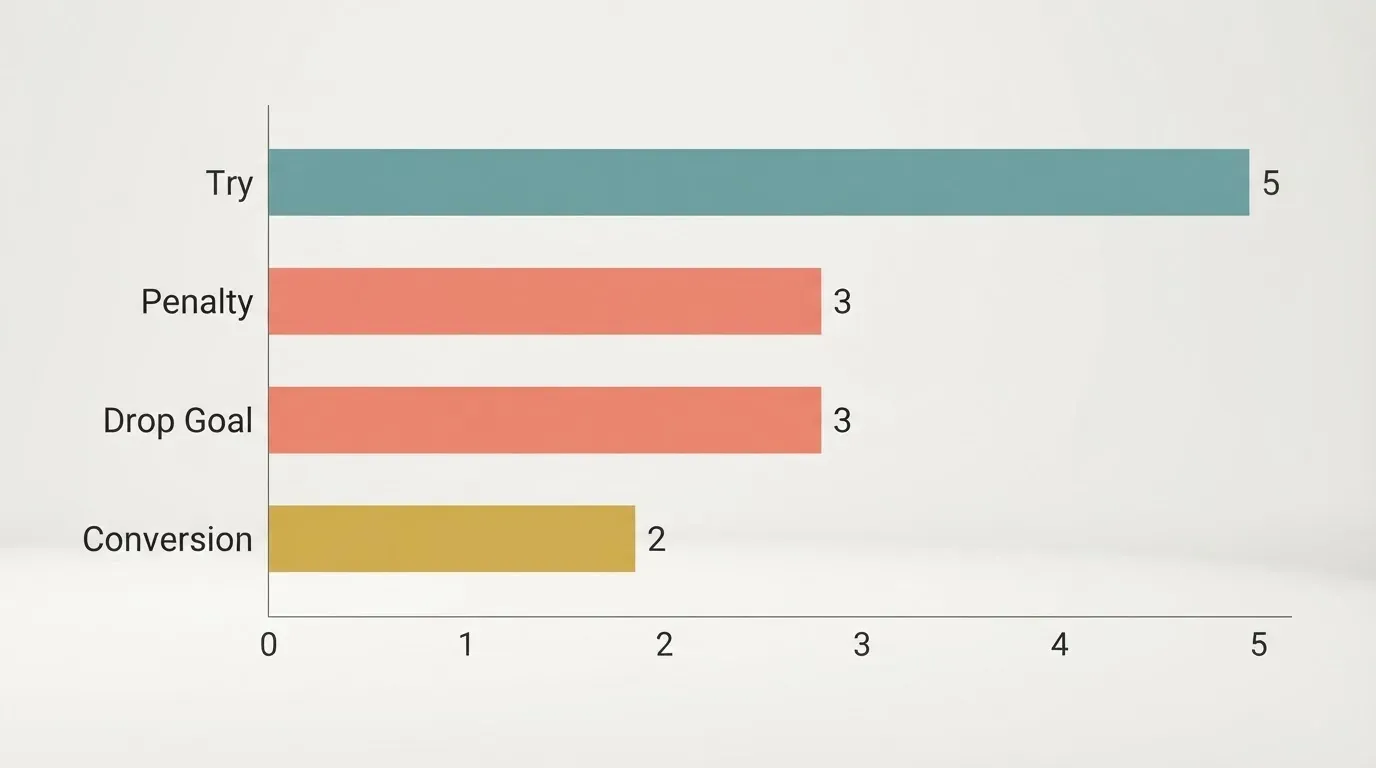
The punter reads the score as a points total, a handicap margin, or a sequence of scoring plays. A total-points market on TAB NZ settles on the final score; a handicap settles on the score adjusted for the line; a first-scoring-play market settles on whether the first points came from a try, a penalty or a drop goal. Bets that depend on player actions — first try-scorer, player to score at any time — settle on the official match statistics published by the governing body of the competition. A player who comes off the bench and scores in the 78th minute counts; a player who is on the pitch at kick-off but does not touch the ball does not.
The key consequence for a punter is that the score in rugby union is low and stop-start. A match that finishes 24-20 produced 44 points, four tries and four successful kicks at goal. A match that finishes 9-6 produced 15 points, two penalty goals and a missed conversion. Total-points markets on rugby union are not football totals of three goals; they are settled in single digits to low thirties, and the bookmaker’s line reflects that. The punter who prices a rugby union total the way he prices an NRL total is overpaying for a market that doesn’t behave the same way.
The rugby union calendar: tournaments and the fixture list
The rugby union calendar runs on a year-long cycle, with international Tests concentrated in the southern-hemisphere winter (July to September) and the northern-hemisphere autumn (November), the Six Nations running February to March, Super Rugby Pacific running February to June, and the Rugby World Cup every four years. The fixture list a punter can bet on depends on which tournaments TAB NZ has priced into its app, which in turn depends on what the betting rules permit.
The Rugby World Cup and its cycle
The Rugby World Cup was first held in 1987 in Australia and New Zealand, and New Zealand won the inaugural title. The tournament has run every four years since, with the next edition hosted by Australia from 1 October to 13 November 2027 — twenty-four teams in six pools of four, fifty-two matches over six weeks. South Africa are the defending champions after beating New Zealand 12-11 in the 2023 final. TAB NZ carries outright winner, group winner, pool qualifier, and head-to-head markets on every World Cup match, with live betting available once the match is underway.
The four-year cycle is the most concentrated rugby union betting opportunity on the calendar. Group-stage matches produce mismatches that attract low margins and outright markets that attract wider margins; knockout matches carry higher margins on individual fixtures because liquidity is concentrated. Punters who treat the World Cup as a six-week tournament and back the favourite to win the final at 3.00 are paying roughly a 30 per cent margin to take the bet on. The same punter backing the favourite to win the pool at 1.20 is paying closer to 5 per cent. The market the punter picks changes the price he pays.
Super Rugby Pacific and the southern hemisphere
Super Rugby Pacific is the premier southern-hemisphere club competition, contested by teams from New Zealand, Australia, Fiji and a Pacific Island franchise. The season runs February to June, with a final in early June. TAB NZ carries full markets on every match — head-to-head, line, total points, first try-scorer — and the All Blacks skew in the squad lists makes it the most widely bet professional rugby union competition in New Zealand.
The fixture density matters. A Super Rugby Pacific round offers five or six matches over a weekend, each with around forty pre-match markets; a punter who wants to bet across the round can place ten or fifteen bets on a Saturday afternoon. The volume tempts the punter to spread the staking budget thinly, which means each bet carries less stake and the margin takes a bigger relative cut. The punter who concentrates stake on two or three reads pays less margin and keeps more of any winnings.
Northern-hemisphere rugby and the autumn internationals
The Six Nations runs February to March, with England, France, Ireland, Italy, Scotland and Wales contesting fifteen matches across five rounds. The autumn internationals in November pull southern-hemisphere teams to the northern hemisphere for Tests against England, France, Ireland, Scotland and Wales. Both windows sit on TAB NZ’s published fixture list, with head-to-head, line and total points markets on every match. The punter betting on a Six Nations match from New Zealand is paying the international-data pricing of a bookmaker with global reach, which generally means tighter margins than a domestic fixture will carry.
Provincial and NPC rugby
New Zealand’s National Provincial Championship (NPC) runs from August to October, contested by fourteen provincial unions. TAB NZ carries outright winner and head-to-head markets on most NPC matches, with line betting available on the heavier games. Provincial rugby is a thinner market than Super Rugby Pacific — fewer matches, smaller fields, narrower liquidity — and the margins reflect that. The punter who backs an NPC outsider at 6.00 is paying closer to a 12 per cent margin than a 5 per cent margin, which is part of why longshots in NPC markets are rarely value.
The bookmaker landscape for New Zealand punters
The bookmakers a New Zealand punter can place a bet with fall into two groups. There is TAB NZ, with its two online brands TAB and Betcha, which together hold the lawful monopoly on racing and sports betting in New Zealand under section 74AAA of the Racing Industry Act 2020. And there is everyone else — international bookmakers with no New Zealand licence, no New Zealand regulator, and no New Zealand complaint framework if a payout is delayed or declined. Both groups are real, but they are not interchangeable, and the differences are large enough that a ranking of one against the other says more about the punter than about the bookmakers.
The table below sets out the shape of the market as it stands.
| Bookmaker | New Zealand status | Rugby union coverage per its own terms | Operator’s main focus |
|---|---|---|---|
| TAB | TAB NZ online brand — sole lawful provider of sports and racing bets in New Zealand under section 74AAA | Rugby union and rugby league listed in the app’s markets, pre-match and live | Racing and sports tote, fixed-odds, multi-platform retail and online |
| Betcha | TAB NZ online brand — same lawful status as TAB | Rugby listed among the app’s covered sports, pre-match and live | Mobile-first racing and sports, same engine as TAB |
| Glorion | Not licensed in New Zealand | Markets grouped by category; no rugby-specific listing found | Pre-match, live, virtual sports and esports |
| Telbet | Not licensed in New Zealand | No sport-specific list given in published terms | Crypto casino and sportsbook |
| Rabona | Not licensed in New Zealand | No sport-specific list given in published terms | Sportsbook launched 23 December 2019 as the sixth Soft2Bet brand |
| Golden Panda | Not licensed in New Zealand | Sports section covers sportsbook broadly; no sport-specific list given | Casino, sportsbook, esports, virtuals and prediction markets |
| Millioner | Not licensed in New Zealand | Football, tennis, table tennis, basketball, ice hockey, American football, baseball — rugby not listed among featured sports | Pre-match and live sportsbook with separate virtuals section |
| RoyalistPlay | Not licensed in New Zealand | Football, basketball, tennis, handball, ice hockey, volleyball, table tennis — rugby not listed among featured sports | Live betting, sports promos, results and schedule |
| Thunderpick | Not licensed in New Zealand | Esports-first — CS2, League of Legends, Dota 2, Valorant — with football and US sports on the sportsbook | Crypto sportsbook and esports |
| LegendPlay | Not licensed in New Zealand | Football, tennis, basketball and ice hockey — rugby not listed among featured sports | Sports, live betting and virtual sports under one account |
The single most important column is the second. A bookmaker’s status in New Zealand is not a footnote; it is the rule that decides who may lawfully take a bet from a person in New Zealand. The table makes the shape visible: two lawful brands, eight without. The cluster of three brands in the middle of the table — Golden Panda, Millioner and RoyalistPlay — explicitly list their featured sports, and rugby union is absent from all three. The punter who wants to bet on rugby union from a TAB NZ account can do so; the punter who wants to bet on rugby union from any of the other brands in the table is betting into a sportsbook that has not marketed the sport among its headline offerings, and that has no New Zealand protection on the wager.
What the rankings actually rank
The two groups in the table cannot be ranked against each other without a false equivalence. A punter choosing between TAB and Betcha is choosing between two products of the same operator group, both lawful, both regulated by the Department of Internal Affairs, both offering the same safer-gambling tools. A punter choosing between TAB and an offshore brand is choosing between a product that answers to the New Zealand regulator and a product that does not. The trade-off is not “which is the better bookmaker” but “which costs the punter more in the things the law cannot fix for him”.
Within the lawful group, TAB is the longer-established brand with retail outlets across New Zealand, a Trackside live race streaming service, and a wallet-and-bet-slip app that has been on the New Zealand App Store since 8 September 2014. Betcha is the newer brand, first released on 6 August 2024, mobile-first, and run by Entain New Zealand Limited under the same TAB NZ umbrella. The products share fixtures, the same odds engine in most markets, and the same deposit and withdrawal tools.
Within the offshore group, the brands rank on their own published offerings: breadth of market, depth of in-play coverage, payment methods accepted, and the design of the betting slip. None of those are New Zealand considerations. The Department of Internal Affairs warns that overseas operators may be in jurisdictions with minimal consumer safeguards, may not return unspent credits, and may not pay out large wins. None of those risks is theoretical; they are the things the regulator warns about.
What a New Zealand punter is actually betting into
The punter who opens the TAB NZ app in 2026 sees a betting slip with rugby union, rugby league, NRL, NBA, NFL, NHL, cricket, football, motorsports, tennis, MMA and esports, plus a horse, harness and greyhound racing section. He can place a single bet, a multi, a Same Game Multi, or bet live while a match is underway. His deposits come from a New Zealand bank account or a debit card; his withdrawals go back to the same bank account. The app carries deposit limits, time-out tools and self-exclusion. He can call the free Gambling Helpline on 0800 654 655 or text 8006 from inside the app.
What he cannot do is shop the line. There is no second lawful bookmaker against which to compare TAB NZ’s odds on a Super Rugby Pacific match, because the law does not allow one. The punter who wants a tighter margin than TAB NZ offers on a given fixture has no lawful New Zealand alternative. He can take the line TAB NZ offers, or he can place the bet with an offshore brand and accept the consequences that flow from betting outside the New Zealand regulatory perimeter.
Those consequences include: no Department of Affairs complaints pathway, no access to the New Zealand self-exclusion framework that applies across TAB and Betcha, no guarantee that a payout dispute will be resolved in the punter’s favour under New Zealand consumer law, and the standing risk that the offshore operator may decline to take further bets from a New Zealand resident at any time. The Department of Internal Affairs has been explicit about those risks in its public warnings. They are not predictions; they are the regulator’s own description of the offshore market.
The punter betting with an offshore brand is also paying the offshore operator’s tax — not New Zealand’s. From 1 July 2024, overseas operators supplying New Zealand residents have paid an online gambling duty of 12 per cent of profits, rising to 16 per cent from 1 January 2027. Tax payment does not make the operator lawful; it does mean a slice of the punter’s lost stake funds the New Zealand revenue base. The point-of-consumption charge on offshore racing and sports bets ceased on 30 June 2026. None of those payments comes out of a winning bet; they are part of the cost of an offshore bookmaker being in the New Zealand market.
How New Zealand regulates sports betting
The legal frame around a New Zealand bet is short and strict. The Racing Industry Act 2020 establishes TAB NZ as the sole betting provider for racing and sports in New Zealand. The Racing Industry Amendment Act 2025 inserted section 74AAA, which came into force on 28 June 2025: no person other than TAB NZ may offer racing betting, sports betting, or other racing or sports betting to a person in New Zealand, regardless of where that person is resident or incorporated. The Department of Internal Affairs told providers serving New Zealand to withdraw with immediate effect. There is no licence to apply for and no licence register for bookmakers, because there is only one lawful provider.
The framework does not stop at the betting operator. TAB NZ and Betcha are the two lawful online brands of TAB NZ, run under a 25-year agreement signed with Entain in 2023 that gives Entain a 50/50 share of gross profits, with at least $150 million a year going to TAB NZ for the first five years and a one-off $100 million payment from Entain to the racing sector. The agreement does not change the monopoly; it changes who runs the monopoly.
What may be bet on
TAB NZ takes fixed-odds and tote (pool) bets, with published betting rules defining Win, Place, Each Way, Quinella, Exacta, Trifecta, First Four, Double, Treble, Daily Double, Running Double, Quaddie and Big6, plus Multis and Same Game Multis. Live betting is listed in the TAB NZ apps. There is no lawful New Zealand betting exchange; spread betting is outside TAB NZ’s sports-betting definition. Bets on politics and novelty markets are not established. There is no statutory per-bet cap; limits are TAB NZ’s own terms.
The ban covers events held inside and outside New Zealand. A bet on the All Blacks in Auckland or on France in Paris is the same bet for the purposes of section 74AAA. The punter is not licensed to place bets with any other operator; the operator is the one on whom the prohibition bites.
What the law does not do
The law does not block offshore websites. The Department of Internal Affairs has not ordered ISPs to geo-block access to unlicensed bookmakers, and the punter can open an offshore account from a New Zealand IP address without technical obstruction. The law puts liability on the operator, not on the punter: section 19(4) of the Gambling Act 2003, inserted in 2025, says an individual may not be convicted for placing a bet with an offshore operator in breach of section 74AAA. The penalty for breaching section 74AAA is not stated in the section, and no prosecution of an offshore bookmaker has been published.
That ambiguity is the practical shape of the regime. The regulator’s statement is that offshore operators serving New Zealand residents are breaking New Zealand law. The punter’s exposure is unprotected, not illegal. The honest framing is that TAB NZ and Betcha are the lawful options with the New Zealand regulator’s oversight and the New Zealand harm-minimisation tools, and offshore operators are operating outside that perimeter with the regulator’s stated risks attached.
Advertising and what the punter sees
The Advertising Standards Authority’s Gambling Advertising Code applies to betting advertisements in New Zealand. Ads must not target children (under 14) or young people (14 to under 18), judged by context, appeal and expected audience — 25 per cent or more of the audience counts as significant where accurate data exists. Ads must not encourage gambling harm and must be truthful with terms available. There is no New Zealand equivalent of a “whistle-to-whistle” betting-advertising ban for sport.
TAB NZ runs bonus bets promotions on major sporting events. No New Zealand rule sets a maximum bonus size or a minimum wagering requirement; the terms are TAB NZ’s own. The punter who takes a bonus bet must read its terms: how many times the bonus must be turned over, what minimum odds apply, and what the deadline is. The same arithmetic that applies to any free bet applies here — the bonus is worth the bonus amount multiplied by the odds-quality of the wagering requirement, and a high wagering factor with a low minimum odds erodes the value quickly.
Tax and what the punter keeps
For the punter, recreational gambling winnings are generally not taxable in New Zealand, and prize money from TAB horse, dog and trotting races is not taxable. A person who bets as a business is a different case. Inland Revenue guidance is general information, not tax advice. The punter who bets regularly and is uncertain about his position must consult Inland Revenue or an accountant.
For the operator, TAB NZ pays the Problem Gambling Levy at 0.74 per cent of gambling revenue, levied from 1 July 2025 to 30 June 2028. The levy funds harm-minimisation services, including the Gambling Helpline. The punter’s stake funds the levy indirectly; the operator’s collection of the levy is the regulator’s way of paying for the safety net.
Safer gambling in New Zealand
The minimum age for betting with TAB NZ is 18, and it is an offence under section 89 of the Racing Industry Act 2020 to bet under 18. The TAB NZ app carries a 17+ App Store age rating and states that customers must be 18 or over to bet. A punter opening a TAB NZ account must verify a New Zealand address and identity — the verification is what makes the age check enforceable. Land-based casinos in New Zealand admit from age 20; the betting age is separate and lower, and the two must not be conflated.
The safer-gambling tools TAB NZ publishes in its app are:
- deposit limits, set by the punter in his account settings;
- time-outs, which suspend the account for a chosen period;
- self-exclusion, which closes the account across both TAB and Betcha for a longer minimum period.
The exclusion applies across the two brands because they share a single operator. The punter who excludes himself from TAB is excluded from Betcha, and vice versa. There is no single national online-betting exclusion register; the register the Online Casino Gambling Act 2026 will require applies to online casinos, not to TAB NZ betting. A punter who has excluded himself from TAB NZ and wants to bet with an offshore brand will find that the offshore brand has no record of his exclusion, and the offshore brand’s own harm-minimisation framework (where the operator runs one) operates independently of the New Zealand framework.
The free Gambling Helpline on 0800 654 655 and the text line 8006 are the public entry points for harm-minimisation support in New Zealand. Safer Gambling Aotearoa is the public-facing education service. Neither is an operator; both are publicly funded. The punter who finds his betting is no longer under control has a New Zealand-language, New Zealand-funded route to talk about it, and that route is the same whether he bets with TAB NZ or with an offshore brand — except that the offshore brand has no obligation to enforce the outcome of any conversation the punter has with the helpline.
Strategy, tips and what a punter can actually control
A rugby union betting tip is somebody’s opinion about what will happen on a rugby field. The opinion may be better-informed than the punter’s own, and it may be worse-informed. The price the punter pays for the tip is the margin baked into the line; the value of the tip is whatever the punter does with it that he will not have done without it. The honest description of the betting-tip industry is that no published tipster beats the closing line on a sustained, after-fee, after-margin basis, and the punters who follow them are paying both the tipster’s fee and the bookmaker’s margin on top of the stake.
What the punter can actually control is the price he pays and the staking plan he follows. Shopping the line, where the law permits, is the single biggest contributor to long-run returns; staking a fixed percentage of bank per bet, with a stop-loss at a chosen threshold, is the single biggest contributor to not losing more than the punter decided to lose. The combination is unglamorous. It does not produce a hot streak. It produces a betting account that lasts longer than the punter’s confidence in any single tip.
A bankroll is the punter’s pot. The punter decides in advance how much of it he will stake on any one bet — 1 per cent, 2 per cent, 5 per cent — and he sticks to it. A punter staking 2 per cent of a $1,000 bankroll is betting $20 a time; a fifty-peg losing streak takes the bankroll to $368 and the per-bet stake to $7.36. The same fifty-peg streak on a 10 per cent staking plan takes the bankroll to $5 and ends the punter’s betting. The lower the per-bet stake, the longer the bankroll survives a run of bad luck, and the wider the range of results the punter can absorb.
A staking plan does not predict winners. It manages the punter’s exposure to losing runs, and it makes the punter’s results a function of his edge rather than a function of his discipline on any given Saturday. The punter who bets bigger when he is winning and smaller when he is losing is doing the opposite; the punter who bets the same fraction every time is doing the right thing for the wrong reason if he has no edge, and the right thing for the right reason if he does.
The deeper question is whether the punter has an edge at all. The bookmaker’s margin guarantees that the average punter loses; the only question is how much. Punters who track their bets, who know their closing-line value, who can point to a sustained record of beating the line before commission, are the only punters for whom staking plans turn into positive returns. The punter who is betting for entertainment pays for his entertainment; the punter who is betting to make money is competing against the bookmaker’s margin and the bookmaker’s data, and that competition is harder than it looks.
Reviewed bookmakers — the ranking in full
The reviews that follow are based on each brand’s published terms and the New Zealand legal frame above. Each reviewed brand is rated on what it actually offers a New Zealand punter, and on what it does not.
TAB
TAB is the longer-established online brand of TAB NZ and the brand most New Zealand punters meet first. The TAB NZ app covers horse and harness racing, rugby union and rugby league, and other sports — pre-match and live. It carries Trackside live race streaming with in-app betting, racing form, Blackbook and Jockey Challenge tools, and a simplified wallet for deposits and withdrawals. The first release of the app was on 8 September 2014, and the product is mature.
The lawful status under section 74AAA is what makes TAB the default option. The punter placing a bet with TAB has the New Zealand regulator’s complaints framework behind him, the New Zealand harm-minimisation tools in his account, and the New Zealand legal system if a dispute escalates. TAB pays the Problem Gambling Levy, which funds the Gambling Helpline. The wager is, in a sense, taxed to pay for the safety net around it.
The downsides are the ones that flow from being the only lawful option. TAB NZ is the only bookmaker a New Zealand punter can compare the line against — and he cannot compare the line against himself. The margins on smaller competitions are wider than the margins a global bookmaker will offer; the Same Game Multi product is more limited than the offshore equivalent; the in-play markets on minor fixtures are thinner. The punter who wants a tight line on a Currie Cup match or a French Top 14 fixture may find TAB NZ’s offering sparse.
For a New Zealand punter who wants the safest place to bet on rugby union, TAB is the answer. The cost is the margin, which is wider than the offshore competition in some markets, and the absence of a second lawful bookmaker against which to shop the line.
Betcha
Betcha is the newer of TAB NZ’s two online brands, first released on 6 August 2024, published on the New Zealand App Store by Entain New Zealand Limited. The product covers horse, greyhound and harness racing plus rugby, NRL, MMA/UFC, NBA, NFL, tennis, cricket, football, motorsports and esports. The design is mobile-first; the feature set is more streamlined than TAB’s, and the betting slip is built for phone-first navigation.
Betcha is not a rival to TAB; it is the second skin of the same operator group. The odds on most markets are the same; the safer-gambling tools are shared; an exclusion at Betcha excludes the punter from TAB and vice versa. The choice between them is a choice of product design — Betcha’s streamlined mobile app versus TAB’s longer-established multi-feature platform — not a choice of operator.
For a punter who wants the lawful New Zealand experience on a phone and is not attached to TAB’s racing tools, Betcha is a competent option. The two brands together are the New Zealand market; the punter choosing between them is choosing between two ways of accessing the same monopoly.
Glorion
Glorion offers pre-match and live betting, virtual sports, horse racing and esports. The published market grouping is into popular, niche, indoor and outdoor sports, with entertainment events such as award shows and elections on the side. The breadth is on the wide side; the depth is modest.
Glorion is not licensed in New Zealand. The brand names no licence that applies in New Zealand, and the Department of Internal Affairs’ standing warning about overseas operators applies. There is no New Zealand complaints route and no New Zealand harm-minimisation framework that reaches a Glorion account.
The published terms do not specifically list rugby union among the headline sports, which means the punter looking to bet on a Super Rugby Pacific match will need to check whether rugby is offered, and at what line. For a New Zealand punter, the fit is poor — the lawful option is a tap away, and the offshore option offers no recourse if anything goes wrong. The brand suits a punter in markets where Glorion is licensed and where the same trade-off is not in play.
Rabona
Rabona launched on 23 December 2019 as the sixth online sportsbook of the Soft2Bet group. The brand carries a sportsbook with pre-match and live coverage and the wider Soft2Bet casino portfolio around it. The Curaçao licence is named in the published terms; no New Zealand licence exists.
The published terms do not specify a sports list, which is the brand’s own product decision. For a punter in a regulated market where Soft2Bet operates, Rabona is one of several Soft2Bet sportsbooks and may be a familiar name; for a New Zealand punter, the trade-off is the standard offshore trade-off — no New Zealand protection, no New Zealand complaints route, and the regulator’s standing warning. The brand’s positioning as a multi-product sportsbook-and-casino does not change the New Zealand position.
Telbet
Telbet describes itself as a crypto casino and sportsbook. The brand’s published terms state a welcome offer framed in Bitcoin plus a USDT free bet, available on its Russian-language site. No licence applies in New Zealand, and the brand’s own positioning is widely weighted toward crypto and a non-English-speaking market.
For a New Zealand punter, Telbet is the wrong fit on three counts. The product is pitched to a Russian-speaking audience; the payment rails are crypto, which the Department of Internal Affairs does not regulate for consumer protection; and there is no New Zealand complaint framework. The punter looking to bet on rugby union with Telbet will be paying in Bitcoin for a product that has no New Zealand protection, and the wager will settle into an account the regulator does not oversee. The fit is poor.
Golden Panda
Golden Panda offers a Sports section with a sportsbook, esports and virtual sports, plus a casino, live casino, crash games, rewards, cashback, a VIP Club, Golden Goals and Prediction Markets. The breadth of verticals is large; the published terms do not specify a sports list. No licence applies in New Zealand.
The product’s positioning is closer to a casino-first brand with a sportsbook attached. The Prediction Markets and crash games are casino products; the sportsbook is a sportsbook. For a New Zealand punter, the casino vertical is unregulated in New Zealand under the Online Casino Gambling Act 2026 framework, and the sportsbook is unregulated in New Zealand under section 74AAA. The brand’s breadth is not a New Zealand asset; it is a reason for the regulator’s standing warning to apply more sharply.
Millioner
Millioner’s sportsbook offers pre-match and live events on football, tennis, table tennis, basketball, ice hockey, American football and baseball. There is a separate Live Betting section and a separate Virtual Sports section. The published sports list is specific, and rugby union is not on it. No licence applies in New Zealand.
For a punter wanting to bet on rugby union specifically, Millioner is the wrong brand — the sport is not in the published list. For a punter in a regulated market betting on football or basketball, the product may be a fit. For a New Zealand punter, the absence of rugby from the published list and the absence of a New Zealand licence both work in the same direction: this is not the brand to back the All Blacks with.
RoyalistPlay
RoyalistPlay’s sportsbook offers live betting, sports promotions, results and a schedule. The top sports listed are football, basketball, tennis, handball, ice hockey, volleyball and table tennis, with separate e-sports and Predictions sections. The Tobique Gaming Commission e-gaming licence (No. 0000002) is named in the published terms; no licence applies in New Zealand.
The published sports list is specific, and rugby union is not on it. For a New Zealand punter wanting to bet on the All Blacks or Super Rugby Pacific, RoyalistPlay is not the right product. The live-betting and sports-promotions infrastructure is real, and for a punter in a market where the Tobique licence is recognised, the brand may fit. In New Zealand, it does not.
Thunderpick
Thunderpick is esports-first, covering CS2, League of Legends, Dota 2 and Valorant. The sportsbook offers a cash-out feature and markets from the Champions League to the NFL, with a Curaçao licence named in the published terms. No licence applies in New Zealand.
The product’s centre of gravity is esports, not rugby union. A New Zealand punter wanting to bet on the All Blacks in a Test match will not find a Thunderpick product built around it. The sportsbook exists, but the brand’s marketing and product design are aimed at esports and American football, not at international rugby union. For a New Zealand punter, the brand’s lack of a local licence and its narrow focus on esports make it an illogical choice for a rugby bet.
LegendPlay
LegendPlay’s sportsbook has Sports, Live Betting and Virtual Sports sections, with football, tennis, basketball and ice hockey listed. The Anjouan Gaming Authority licence is named in the published terms; no licence applies in New Zealand. The published sports list is specific, and rugby union is not on it.
For a punter wanting to bet on rugby union from New Zealand, LegendPlay is the wrong product — the sport is not on the published list, and the licence is not a New Zealand licence. For a punter in a market where the Anjouan licence is recognised and the football or basketball offering is the draw, the brand may fit. A New Zealand punter will find neither a local licence nor a rugby offering, so this is not a suitable platform for the sport.
Frequently asked questions
What is a three-way rugby union bet?
A three-way rugby union bet offers three outcomes: home win, draw, or away win. It is the default result market for a rugby union match, particularly in the World Cup group stage and domestic competitions where a drawn match is a possible result. Because the draw outcome is hard to price accurately, three-way markets carry a wider bookmaker margin than handicap markets on the same match.
Who is allowed to take sports and racing bets in New Zealand?
Since 28 June 2025, section 74AAA of the Racing Industry Act 2020 allows only TAB NZ, through its two online brands TAB and Betcha, to take sports and racing bets from a person in New Zealand. There is no licence to apply for and no register of bookmakers, because the law names a single lawful provider. Any other brand taking bets from a New Zealand resident is operating outside the New Zealand regulatory perimeter.
How is a winning payout calculated from the stake and the odds?
For a single bet, multiply the stake by the decimal odds: a $20 stake at 1.90 returns $38, which is the $20 stake plus $18 of profit. For a multi, multiply the stake by all of the leg prices: a $10 stake at 2.10, 1.80 and 1.95 returns $73.71 if all three legs win. Every leg must win for a multi to pay; one loser loses the entire stake.
What does the bookmaker’s margin mean and how is it hidden in the odds?
The margin is the slice of every dollar bet that the bookmaker retains on average. It is hidden in the odds because the implied probabilities on a market sum to more than 100 per cent, and the excess is the margin. A two-way market at 1.90 on each side has a 95 per cent payout share and a 5 per cent margin; the wider the margin, the less of the punter’s stake comes back as winnings on average. Margin is the price a punter pays to bet.
What does a New Zealand punter lose by betting with an unlicensed bookmaker?
An unlicensed bookmaker is operating outside New Zealand law, and the New Zealand regulator’s complaints framework does not reach it. The punter has no recourse through the Department of Internal Affairs if a payout is delayed or declined, no access to the New Zealand self-exclusion framework, and no guarantee that New Zealand consumer protection law will apply to a dispute. The Department of Internal Affairs has publicly warned that overseas operators may not return unspent credits and may not pay out large wins.
Rugby, league & cricket – leaguebetsnz
Content created by the «leaguebetsnz» team
