
UFC Betting in New Zealand: The TAB NZ Reality and What It Means for Punters
 Available in US
Current as of October 30, 2026. Verified against TAB NZ’s own terms, the Racing Industry Act 2020 (section 74AAA), and the Department of Internal Affairs guidance.
A New Zealand punter who wants to back a UFC main event has nowhere near the choice a UK or Australian punter takes for granted. Since 28 June 2025, an amendment to the Racing Industry Act 2020 makes TAB NZ — and its online sister Betcha — the only operators lawfully allowed to take racing and sports bets from people in New Zealand. The Department of Internal Affairs told unlicensed providers to withdraw with immediate effect. The headline consequence: if a UFC fight is on Saturday in Las Vegas and a New Zealander wants a wager on it, TAB NZ or Betcha is the only lawful way to place it.
The UFC itself has run since 12 November 1993 in Denver, Colorado, and is now owned and operated by TKO Group Holdings with Dana White as president since 2001. By 2026 the promotion had held over 750 events across eight men’s and three women’s divisions. That scale pulls global betting interest. New Zealanders follow it through streaming and pay-per-view, and a slice of them want to bet on what they watch. This page sets out what New Zealand law lets them do, where TAB NZ’s UFC offering sits among its wider sports menu, how UFC odds are built and what the margin inside them looks like, and how the responsible gambling tools the law requires compare with what an unlicensed offshore bookmaker can or cannot offer a New Zealand resident.
Safer Gambling in a Closed Market
A market with one licensed operator concentrates the responsible gambling duty. TAB NZ lists deposit limits, time-outs and self-exclusion across its app, and an exclusion applies across both of its brands — TAB and Betcha — because they share the same account infrastructure. The free Gambling Helpline at 0800 654 655 (text 8006) and Safer Gambling Aotearoa sit beside the app’s controls. TAB NZ also pays a Problem Gambling Levy of 0.74% on its gross proceeds, a figure locked in from 1 July 2025 to 30 June 2028, which funds the harm-minimisation work that the regulator and the helpline run.
The practical effect is that TAB NZ’s controls reach a New Zealand punter in a way no offshore brand can. A punter who self-excludes through TAB NZ is excluded across both New Zealand brands for the period they set; the same exclusion does not stop them opening an account with an offshore bookmaker that has no presence in New Zealand and no duty to honour it. The Department of Internal Affairs states plainly that overseas operators may be in jurisdictions with minimal consumer safeguards, may not return unspent credits and may not pay out large wins. That warning sits inside the responsible gambling frame because it is the same risk: harm minimisation depends on the operator honouring the tools.
Three points follow from this. First, a New Zealand punter who wants cooling-off tools that actually bite has one operator to use them through. Second, harm minimisation in this market is regulator-supervised through TAB NZ’s levy-funded obligations, not through a public register of self-excluded players — there is no single national online-betting exclusion register because the casino law’s planned register is for online casinos only. Third, where a punter sets a deposit limit and then opens an offshore account to bypass it, the limit has done its job for TAB NZ and nothing for the offshore book; the offshore account is a separate decision the punter makes on their own.
If gambling is causing harm, the gambling helpline at 0800 654 655 is free and confidential. Text 8006 for the same service. Safer Gambling Aotearoa provides information, support and referral to counselling services across the country.
The TAB NZ App and What UFC Looks Like on It
TAB NZ publishes its betting app “TAB – Racing & Sports Betting” on the New Zealand App Store under the seller name New Zealand Racing Board, first released 8 September 2014. Betcha is a separate app published by Entain New Zealand Limited, first released 6 August 2024. Both run from the same TAB NZ infrastructure, and both touch the same fixed-odds and pool betting engine. The TAB NZ app carries a 17+ App Store age rating and states that customers must be 18 or older to bet — the betting age is set under section 89 of the Racing Industry Act 2020, separate from the 20+ age for land-based casinos.
The app’s built-in features centre on racing — trackside live race streaming with in-app betting, racing form, Blackbook (a punter’s notebook of horses to follow) and Jockey Challenge. A simplified wallet handles deposits and withdrawals, and the sports module covers horse and harness racing, rugby union, rugby league and other sports. UFC sits inside that “other sports” section: TAB NZ’s sports-betting definition is wide enough to cover combat sports, and the dedicated UFC fight cards show up alongside the rugby and basketball markets.
Mobile betting in New Zealand is the default, not a quirk. Punters place bets from a handset more often than from a desktop, and the TAB NZ and Betcha apps are built around that. The trade-off is that the apps cannot offer what an offshore bookmaker’s app might — a slick bet-builder with twenty market types, or an in-play interface repopulating every second. UFC in-play betting through TAB NZ is listed in the apps, but the breadth of market is narrower than what a Curaçao or Anjouan bookmaker running on a global platform can field. The choice a New Zealand punter faces is not between two apps; it is between the law and a wider menu.
Betcha, the second TAB NZ brand, runs on the same engine and carries the same markets in a different wrapper. For UFC specifically, there is no meaningful difference: the fight card, the prices and the markets are pulled from the same feed. The reason both brands exist is to give TAB NZ coverage of the online sports-betting audience in two segments — the established TAB customer and a newer mobile-first punter who might not think of the TAB as a sports product. UFC punters will see the same prices either way.
UFC Betting Predictions and Strategy: Why Forecasts Fail Before They Start
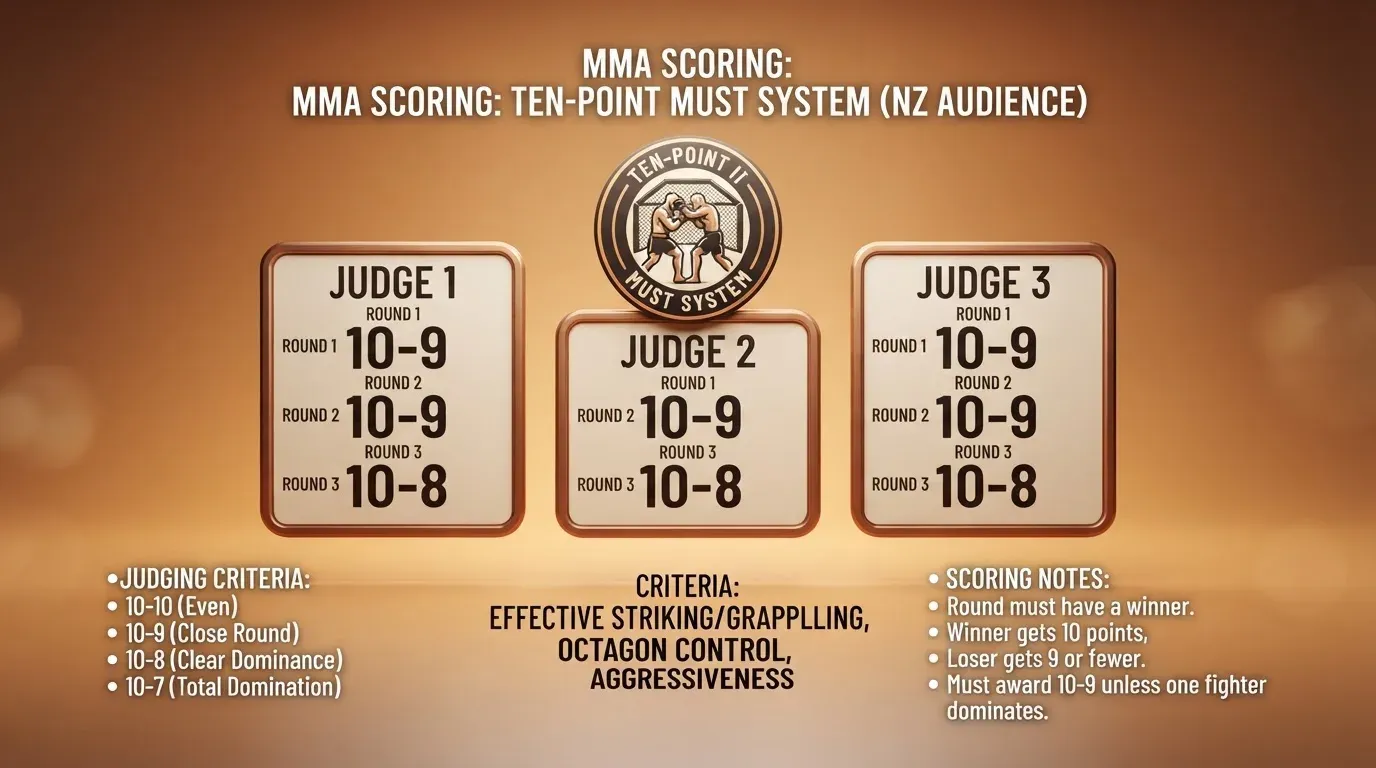
The UFC is the one major sport where “best bets today” and “fight night tips” content multiplies fastest and means the least. A UFC bout lasts up to five rounds of five minutes each, with one minute’s rest between rounds, and a championship or non-title main event is scheduled for the maximum five rounds; other bouts go three. A bout can end by submission, knockout, technical knockout, judges’ decision (unanimous, majority, split or technical) or disqualification — and it can also be ruled a no contest. Three judges at cageside score each round on the ten-point must system: the winner takes 10, the loser 9 or fewer, and 10-8 is the score for a dominant round. If a UFC title fight ends a draw, the defending champion retains the title.
That shape — short fights, decisive finishes, judges’ splits — is why UFC tipster content reads so loudly and predicts so poorly. A betting tip on a UFC fight is a judgement about two athletes’ likelihood of finishing each other inside a small window of time, with finishes ranging from a single punch to a five-round grind on the cards. The statistical surface is shallow: most fighters have fewer than ten UFC appearances at the top of a card, and the fighter who broke through at UFC 250 is on the main card of UFC 280 with a record that has changed since. Anyone selling “ufc best bets today” or “ufc fight night betting tips” is selling a forecast with a sample size too small to support it.
For a New Zealand punter specifically, the advice that survives the noise is structural. Bankroll discipline beats prediction skill in a sport with this much variance — staking a small, fixed percentage of bank on each fight, never chasing losses, walking away from a card that is too unpredictable to read. The model that wins UFC betting over time is the model with the smallest ruin rate, not the largest pick accuracy. The market margin sits on every price, so the edge has to come from somewhere real — spotting a mispriced underdog, betting only when the price justifies the line, skipping fights where the offer reads as a coin flip with vig. That is not a tip; it is the work that a tip is supposed to replace.
The shortcut that does not work: betting every main card because the fight looks “obvious”. UFC fights end in upsets often enough that an “obvious” favourite at short odds is a thin wager at best, with the bookmaker’s margin compounding the problem. The shortcut that works: fewer bets, better prices, a long horizon. New Zealand’s TAB NZ monopoly does not change this math — the margin TAB NZ applies to a UFC market is the margin any other bookmaker applies, and a bad price at TAB NZ is the same loss as a bad price elsewhere.
UFC Bet Types, Odds and How the Margin Sits Inside Them
A UFC fight card offers a market list that a football or rugby punter recognises: head-to-head (who wins), method of victory (KO/TKO, submission, decision), round betting, total rounds over/under, and “fight to go the distance” as a yes/no. Same-game multis — a bet with several legs drawn from one event — are a TAB NZ feature, and a multi whose legs all land multiplies the odds into one price. Live betting is available in the TAB NZ apps, and the in-play market is narrower than the pre-match card but covers the basics.
The mechanics of the odds — the decimal price a punter sees at $2.10, the stake they put up, the return they get back — work the same everywhere. A winning single bet returns stake multiplied by the odds. A $10 wager at odds of 2.50 returns $25: the $10 stake comes back, and $15 of profit sits on top. A combination bet multiplies the odds together; three legs at 1.80, 2.00 and 2.50 become one price of 9.00, and a $10 stake returns $90 if all three land. The minimum price that counts as a winner on a multi leg is set by the bookmaker’s own rules, and a void leg settles the multi in a way the rules define — at TAB NZ, a void leg on a same-game multi typically leaves the rest of the bet running.
What the punter pays for that return is the margin. The margin is the share of every dollar bet on a market that the bookmaker keeps on average, after all winning bets have been paid out. The margin sits inside the odds themselves: every price is a touch below what a perfectly fair market offers, and the gap across all outcomes of one market is what the bookmaker earns. The only thing that distinguishes a sharp bookmaker from a soft one is how small that gap is.
A worked example makes the math visible. Take an illustrative two-way UFC market priced at 1.90 and 1.90 — a coin-flip fight with no margin in either direction. The payout share on a market with odds of 1.90 and 1.90 is one divided by the sum of the inverse odds: 1 ÷ (1/1.90 + 1/1.90) = 1 ÷ (0.5263 + 0.5263) = 1 ÷ 1.0526 = 0.9500, or 95.00%. The margin is the rest: 1 minus 0.9500 = 0.0500, or 5.00%. For every $100 bet on this market across both outcomes, $95 comes back to winning punters on average and $5 stays with the bookmaker. A market priced at 1.85 and 1.85 returns 92.50% to punters and keeps 7.50% — a thicker margin by 250 basis points. Real UFC markets rarely sit at the absolute fair line of 1.90/1.90; most show a margin of between roughly 5% and 9% on the main card, depending on how the bookmaker sizes the favourite.
That band is the practical answer to the question of how much the margin costs. The expected loss from a $50 wager at 5% margin on a one-off market is $2.50; at 8% it is $4.00; at 12%, on a poorly-sized exotic, it is $6.00. These are average losses over many bets — the math of variance, not a promise about any one wager. A multi bet compounds the margin across its legs, and a same-game multi with four legs at 7% margin each carries an effective margin in the high twenties. The page does not endorse any specific wager, but it can say plainly: the more legs a bet has, the larger the margin inside it, and the smaller the edge a punter needs to call to come out ahead.
The UFC Calendar and Where the NZ Punter Meets It
The UFC runs events numbered in sequence — UFC 334, UFC 335 and so on through the year — across venues from Las Vegas to Madison Square Garden. Two events on the 2026 calendar: UFC 334 (Gane vs. Hokit) is scheduled for 14 November 2026 at Madison Square Garden, New York City, and UFC 335 (Oliveira vs. Lopes) for 12 December 2026 at T-Mobile Arena, Las Vegas. Fight night events fill the weeks between the numbered cards, and the regional fight cards out of Apex in Las Vegas keep the calendar full.
For a New Zealand punter, the time zone is the structural fact. UFC main cards out of Las Vegas start at 10:00 a.m. or 11:00 a.m. New Zealand time on a Sunday morning, depending on the undercard length. The big cards land when New Zealanders are at brunch or at the rugby — a slot that pushes same-day betting on TAB NZ’s app rather than a Saturday night punt on the couch. Live in-play betting through TAB NZ stretches past the main event; the preliminary bouts come earlier and the main card finishes in the early afternoon NZ time.
Fight week itself follows a routine the betting market knows. Tuesday is fight announcement and press conference; Wednesday is open workouts; Thursday is the pre-fight press conference with all fighters and the ceremonial weigh-ins on Friday. The betting market moves with the news: injury replacements, weight-cut news, a fighter pulling out late — each one shifts prices and shortens or lengthens odds. A New Zealand punter following the sport from a 20-hour time difference is reacting to news that broke overnight, which means the TAB NZ price a punter sees at 9:00 a.m. Saturday reflects everything that has happened overnight in the US.
The deeper structure that drives UFC betting volume is the title picture. Each weight class has a champion; divisions cycle through challengers ranked one through fifteen or so; a new champion resets the contenders at the top. A title fight is the largest single betting event on the UFC calendar, and a non-title main event built around two top-five contenders pulls volume close behind. Fight cards outside that frame — Apex regional events, debut fighters, replacement bouts — carry thinner markets and wider margins. The result: the most attractive UFC bets in calendar terms are the biggest fights, and the worst-priced UFC bets are the smallest cards. That is a pattern TAB NZ’s offering follows alongside every other bookmaker running the sport.
The Ten Operators in This Comparison, and What Each Brings
The table below covers ten brands. TAB and Betcha are the two online brands of TAB NZ, and they sit first because they are the only lawful operators (Racing Industry Act 2020, Section 74AAA). The other eight brands are bookmakers New Zealanders meet online through search results, sponsored content and offshore marketing — Rabona, RoyalistPlay, BillyBets, Winz.io, 22Bet, Sportaza, Thunderpick and BetNinja — and each is marked as not licensed in New Zealand. They are listed because a New Zealand punter comparing options sees them; the table does not treat them as equivalent to the licensed brands.
| Brand | New Zealand status | What the operator’s own terms state on UFC betting |
|---|---|---|
| TAB | TAB NZ brand — the only lawful operator | UFC on the wider sports menu alongside rugby and racing; live in-play listed in the app; same-game multis available |
| Betcha | TAB NZ brand — the only lawful operator | Same TAB NZ feed and markets; same UFC card, same prices, different app |
| Rabona | Not licensed in New Zealand | Combat sports listed within a wider sportsbook offering over 30 market types per event |
| RoyalistPlay | Not licensed in New Zealand | Live betting and a sports schedule section; UFC market depth not confirmed in the operator’s terms |
| BillyBets | Not licensed in New Zealand | Combat sports named among covered sports alongside football and tennis; same-account casino and sportsbook |
| Winz.io | Not licensed in New Zealand | Sportsbook T&C separate from casino terms; UFC market coverage not confirmed in the published terms |
| 22Bet | Not licensed in New Zealand | Over 30 market types per event including 1X2, totals and handicaps; UFC market structure not confirmed in the operator’s terms |
| Sportaza | Not licensed in New Zealand | Cash out, Bet Builder, same-game voids, interval markets in 1-, 5-, 10- and 15-minute ranges |
| Thunderpick | Not licensed in New Zealand | Cash out and a broad sports menu from Champions League to the NFL; UFC depth not confirmed in the operator’s terms |
| BetNinja | Not licensed in New Zealand | Casino and sports under separate offers; UFC market terms not published in the visible terms |
The column on TAB and Betcha restates the same point they share: under section 74AAA they are one operator group, never rivals, with the same UFC prices under two app skins. The offshore columns are narrower where the operator’s own terms carry less on UFC specifically than on football — a pattern that holds across the listed brands and a reason the table cannot promise a feature for every row. Offshore brands cannot lawfully take bets from people in New Zealand since 28 June 2025; for the relevant entries the figure-bearing cells reflect market structure as published, and the New Zealand status column carries the legal reality.
Operator Reviews
TAB
TAB is one of two online brands of TAB NZ, the sole provider lawfully offering racing and sports betting in New Zealand (see Section 74AAA). The licence is held by TAB New Zealand, and the operation is run by Entain under a 25-year agreement signed in 2023 that gives Entain a 50/50 share of gross profits, with at least $150m a year going to TAB NZ for the first five years and a one-off $100m payment pledged to the racing sector. TAB the retail network and TAB the online brand are the same operator on different rails.
The UFC sits inside TAB NZ’s wider sports menu rather than as its own dedicated vertical, which is how the law treats it: there is no licence register for bookmakers because there is only this one lawful provider, and the UFC market list comes from TAB NZ’s own published terms. The “TAB – Racing & Sports Betting” app carries the operator’s brand and runs on the same fixed-odds engine. UFC cards show up alongside rugby and racing; live in-play is listed in the app; same-game multis are available.
For the New Zealand punter: the verdict on TAB is that it is the lawful route by definition, not by comparison — every other operator offering UFC betting to a person in New Zealand is breaking section 74AAA. The price a punter sees at TAB NZ for a UFC main event is the only price they can place on a market that has New Zealand regulator oversight and a New Zealand complaints route. The trade-off is the menu: TAB NZ’s UFC market depth tracks what a single-operator closed market offers, not what a global bookmaker running on a Curaçao licence can field. For most UFC punters in New Zealand that is a fair exchange — a slimmer market list in return for a market that is legal and that has the responsible gambling tools the New Zealand harm-minimisation framework expects.
Betcha
Betcha is the second online brand of TAB NZ. The app is published by Entain New Zealand Limited on the New Zealand App Store and was first released on 6 August 2024. Like TAB, Betcha runs on the same TAB NZ fixed-odds engine and carries the same UFC market list — the difference is the brand and the audience Betcha was built to reach: a mobile-first online sports punter who might not otherwise think of the TAB as a sports-betting brand.
In the comparison: Betcha is not a rival to TAB; it is the same operator’s product aimed at a different segment. The UFC prices are identical to TAB’s because they come from the same feed; the responsible gambling controls (deposit limits, time-outs, self-exclusion) apply across both brands through the same TAB NZ account infrastructure. A punter who self-excludes through TAB is self-excluded from Betcha; a punter who sets a deposit limit at TAB carries the same limit at Betcha. That is the trade for the brand-segmentation strategy: the safety rails run across the operator, not per app.
Betcha offers nothing UFC-specific that TAB does not, but it offers a different app; for a punter who has not built the TAB habit, that matters. The market depth is the same. The only real test is which app feels easier to use on a Sunday morning with the UFC card in the in-play window.
Rabona
Rabona launched on 23 December 2019 as the sixth online sportsbook of the Soft2Bet group and runs on a Curaçao licence. The brand offers over 30 market types per event in its wider sports menu — a figure comparable to other global sportsbooks. UFC markets fit the same template, with the structure of head-to-head, method of victory and round betting visible where the operator publishes.
In New Zealand terms: Rabona is not licensed. Only TAB NZ is lawful (Section 74AAA). Curaçao licences permit no bets from New Zealand, and there is no local complaints route or harm-minimisation. The DIA has warned unlicensed providers to withdraw.
Rabona’s UFC offering is broader in market depth than what TAB NZ publishes, but the legal and consumer position is the trade-off. A punter signing up with Rabona from a New Zealand address uses an operator that has no lawful route to take the bet, no New Zealand regulator, and no path to a payout dispute. The DIA’s risks apply in full. For comparing UFC options, the depth of Rabona’s market list sits beside that picture, not on its own.
RoyalistPlay
RoyalistPlay operates under a Tobique Gaming Commission e-gaming licence (No. 0000002), with the holder named as Novatrix SRL. The sportsbook offers live betting, sports promotions, results and a schedule, with football, basketball, tennis, handball, ice hockey, volleyball and table tennis among the top sports, plus separate e-sports and Predictions sections. UFC is not named in the operator’s published home-page content alongside the top sports.
In New Zealand terms: RoyalistPlay is not licensed. Only TAB NZ is lawful. Tobique licences permit no bets from New Zealand, and there is no local complaints route or harm-minimisation.
RoyalistPlay’s home-page content reads football-first, with the top sports list pointing the operator’s product build away from combat sports. A New Zealand punter choosing RoyalistPlay for UFC chooses a brand the operator’s marketing does not put UFC on — a thinner UFC product than a global bookmaker that names combat sports first. The lawful option remains TAB NZ.
BillyBets
BillyBets runs a casino and a sportsbook under one account, with the sportsbook covering football, tennis, table tennis, basketball, ice hockey, American football, baseball, combat sports, esports, virtual sports and live betting. Combat sports sits explicitly in the listed sports — wider than RoyalistPlay’s home-page content. The site publishes no dedicated UFC vertical beyond the sportsbook menu.
In New Zealand terms: BillyBets is not licensed — only TAB NZ is lawful. There is no New Zealand complaints route or harm-minimisation framework, and the brand names no applicable licence.
BillyBets names combat sports among its covered sports, closer to a UFC fit than a football-only sportsbook. A New Zealand punter choosing BillyBets for UFC checks the operator’s terms for market depth on the next card. The lawful option, for any UFC bet, is TAB NZ.
Winz.io
Winz.io runs a sports betting bonus promotion with separate Sportsbook T&C, Sports Rules and Bonus Terms and Conditions pages. The structure of separate sportsbook terms is the kind of paperwork pattern a multi-brand casino operator uses to keep casino and sports terms from running into each other. UFC market coverage is not visible on the home page; the operator’s primary vertical is casino and live casino.
In New Zealand terms: Winz.io is not licensed. Only TAB NZ is lawful. Anjouan/Tobique licences permit no bets from New Zealand, and there is no local complaints route.
Winz.io’s public-facing content centres on casino, with sports as a secondary product. A New Zealand punter comparing UFC options faces the same legal position as with every other offshore brand — the law treats offering sports bets from New Zealand as breaking Section 74AAA. The lawful option is TAB NZ.
22Bet
22Bet offers over 30 market types per event in its wider sports menu, including 1X2, Double Chance, totals, both teams to score, correct score and HT-FT, plus tennis game, set and handicap markets. The breadth tracks the global sportsbook template. UFC fits the same wide-market structure where the operator publishes it.
In New Zealand terms: 22Bet is not licensed — only TAB NZ is lawful.
22Bet’s market breadth is the kind a global sportsbook running on a Curaçao licence can field — wider than what TAB NZ publishes for UFC. The trade is the same as for every other offshore brand: the menu is broader but the legal position is weaker. A New Zealand punter has no New Zealand regulator, no harm-minimisation framework, and a DIA warning about payouts. TAB NZ remains the lawful option.
Sportaza
Sportaza offers cash out before an event or market is finalised, Bet Builder (where one void selection voids the whole betslip), multiples, Asian lines and interval markets in 1-, 5-, 10- or 15-minute ranges. The feature set is the kind a global bookmaker using an Anjouan licence can publish: cash out, bet builder, asian handicaps, interval markets.
In New Zealand terms: Sportaza is not licensed — only TAB NZ is lawful. Its Anjouan licence offers no right to take bets from New Zealand, and there is no New Zealand complaints route.
Sportaza’s published features are attractive: cash out, bet builder, Asian lines and interval markets. None of these features change the legal picture for a New Zealand address. A punt at Sportaza from New Zealand is a punt the operator has no lawful route to take. TAB NZ is the only operator with that route.
Thunderpick
Thunderpick is esports-first, covering CS2, League of Legends, Dota 2 and Valorant, and its sportsbook offers a cash-out feature and markets from the Champions League to the NFL. The esports emphasis shapes the brand’s product more than a football-first bookmaker’s. UFC falls in the secondary sports book.
In New Zealand terms: Thunderpick is not licensed — only TAB NZ is lawful. Its Curaçao licence offers no right to take bets from New Zealand, and there is no New Zealand complaints route.
Thunderpick’s esports-first product is not a UFC-first product. A New Zealand punter choosing Thunderpick for UFC chooses an esports-native brand for a sport it does not foreground — likely a thinner UFC offering than a bookmaker that names combat sports first. The legal position is the same as the rest of the offshore list. TAB NZ remains the lawful option.
BetNinja
BetNinja publishes a casino welcome offer of EUR 1,000 bonus plus 100 free spins and a separate sports offer of a 100% match up to EUR 100 on the first deposit. The casino and sports welcome structure is a common global-template pattern. UFC terms are not visible on the home page.
In New Zealand terms: BetNinja is not licensed — only TAB NZ is lawful. Its Comoros licence offers no right to take bets from New Zealand, and there is no New Zealand complaints route.
For the New Zealand punter: the verdict is that BetNinja’s published welcome offers are explicit — EUR amounts, percentages, free spins — but UFC market depth is not carried in the operator’s first-page terms. A New Zealand punter checks the actual UFC card on the operator’s site rather than using the welcome page. The lawful route for any UFC wager from New Zealand is TAB NZ.
How UFC Betting Works in a Closed-Market Context
Step one is the law. Since 28 June 2025, the Racing Industry Act 2020 (section 74AAA) makes TAB NZ the only provider that may lawfully offer racing and sports betting to a person in New Zealand. Betcha is a second TAB NZ brand and not a separate bookmaker. There is no licensing route for another operator, because the law does not provide for one. The market list of TAB NZ comes from its own terms, which cover racing codes (thoroughbred, harness and greyhound — with greyhound closing from 1 August 2026) and a sports menu that includes rugby, basketball and combat sports, including UFC.
Step two is the account. TAB NZ requires a verified New Zealand address and ID; offshore brands do not, because they are not New Zealand-licensed and have no reason to verify one. The verification requirement is part of why TAB NZ’s controls work — they know who the account holder is, where they are, and how to apply a deposit limit or self-exclusion. Offshore brands verify where their own terms say they verify, and the Department of Internal Affairs’ position is that the safeguards at the offshore end can be minimal.
Step three is the bet. Fixed-odds and pool (tote) betting are both available through TAB NZ; the betting types TAB NZ publishes include Win, Place, Each Way, Quinella, Exacta, Trifecta, First Four, Double, Treble, Daily Double, Running Double, Quaddie and Big6 for racing, and a similar list of head-to-head, line and multi markets for sports betting. UFC markets sit in the sports-betting arm. The minimum stake and any wagering requirements on bonus bets come from TAB NZ’s terms only — there is no New Zealand rule on bonus-bet size or wagering terms, and no rule to copy one from.
Step four is the return. A winning bet returns stake multiplied by the odds, with a multi multiplying the odds across its legs. A bonus-bet stake is typically not paid back with the win, so the value of a bonus bet settles on the profit rather than the return. A tote bet pays a dividend that depends on the pool; the maths is different. The settle is what TAB NZ’s terms describe, applied to the bet the punter placed.
Step five is the harm check. TAB NZ provides deposit limits, time-outs and self-exclusion within its apps, and the Gambling Helpline (0800 654 655, text 8006) and Safer Gambling Aotearoa are independent of the operator. The self-exclusion applies across the TAB NZ brands (TAB and Betcha). An offshore brand’s tools are bound by its own house rules; the Department of Internal Affairs’ warning about minimal consumer safeguards applies.
The closed market is not what New Zealand punters from the early 2000s remember. There is no offshore route with local protection. A New Zealand punter who wants a bet on UFC that has New Zealand regulator oversight and a complaints pathway bets through TAB NZ or Betcha. There is no other lawful path.
The Law Behind the UFC Bet, in Plain Terms
The Racing Industry Act 2020 establishes TAB NZ as the sole betting provider for racing and sports in New Zealand. The Racing Industry Amendment Act 2025 inserted section 74AAA, which prohibits any other person from offering racing betting, sports betting or other racing or sports betting to a person in New Zealand, regardless of where that person is resident or incorporated. The change took effect on 28 June 2025, and the Department of Internal Affairs told providers serving New Zealand to withdraw with immediate effect. There is no licence register for betting in New Zealand because there is only one lawful operator; the operator’s right to offer betting does not come from a licence — it comes from the absence of any other lawful route.
The Gambling Act 2003 remains the framework statute: the Department of Internal Affairs is the gambling regulator and monitors compliance with the betting prohibition (Racing Industry Act 2020, section 92A). The law does not geo-block offshore websites; it puts liability on the offshore operator. New Zealand law targets the operator. The Department of Internal Affairs warns players of the risks. The player side: section 19(4) of the Gambling Act 2003 (inserted in 2025) says an individual may not be convicted for placing a bet with an offshore betting operator in breach of section 74AAA; no source states a penalty for a player. The framing the page uses, then, is the honest one: TAB NZ and Betcha are the only lawful option, with New Zealand harm-minimisation tools, regulator oversight and a complaints framework; offshore is unlawful for the operator to serve New Zealand, with no New Zealand complaints route, the Department of Internal Affairs’ stated risks, and limits available elsewhere. Neither is “the safe choice” by default.
The point-of-consumption charge on offshore racing and sports bets ceased on 30 June 2026 — a tax change rather than a law change. The prohibition on offering bets from offshore to New Zealand residents remains in force. The Online Casino Gambling Act 2026 licenses online casino gambling only and does not license sports betting; TAB New Zealand winning the right to apply for a casino licence does not extend the betting monopoly. Greyhound racing is closing in stages from 1 August 2026, and from that date offshore operators may not take bets on greyhound races either.
The advertising frame: only TAB NZ may offer betting here, and the Department of Internal Affairs reads the prohibition as covering the promotion of such bets by another operator. The Advertising Standards Authority’s Gambling Advertising Code applies to betting advertisements and includes the rules that ads must not target children (under 14) or young people (14 to under 18), judged by context, appeal and expected audience, and must not encourage harm or mislead. How the Department of Internal Affairs treats betting affiliates is not established in the public materials this page reads.
Calculating the Cost: A Worked Margin Example
A useful price for a UFC coin-flip market — say two fighters priced close together — is around 1.90 on each side. The math runs like this. The payout share on a market priced at 1.90 and 1.90 is one divided by the sum of the inverse odds: 1 ÷ (1/1.90 + 1/1.90) = 1 ÷ 1.0526 ≈ 0.9500, or about 95.00%. The margin is the rest: 1 − 0.9500 = 0.0500, or 5.00%. For a $100 stake split evenly across both outcomes on a two-way market at that margin, the bookmaker keeps $5 on average and pays out $95.
Real markets don’t sit at the absolute fair line. Most UFC two-way markets show a margin between roughly 5% and 9% on the main card — the lower end for liquid markets and the higher end for thinner ones. A market priced at 1.85 and 1.85 (still a coin flip, just trimmed) gives a payout share of about 92.50% and a margin of about 7.50% — a 250-basis-point difference from the 1.90/1.90 example. The same dollar split at that margin keeps $7.50 on every $100. A market with wider margins — exotic round bets, “fight to go the distance” yes/no on a fight with a heavy favourite, same-game multis compounding legs — sits in the 10–15% margin territory, and a multi of four legs at 7% margin each has a compounded margin near 25%.
The conclusion: the margin is the cost of every bet a punter places, and on UFC the bands are visible to a punter who runs the numbers. The expected cost on a $50 wager at 5% margin is about $2.50; at 8% it is $4.00; at 12% it is $6.00. None of these figures is a guarantee — they are averages across many bets under the assumption that the punter bets at the model’s true probability and the margin is the only edge. A punter betting under the fair line loses on every wager, on average, at the rate the margin implies.
The same arithmetic applies at TAB NZ as at any other bookmaker. The closed market does not change the margin a punter faces inside a UFC price; it only changes the menu. A 5% margin at TAB NZ is the same cost as a 5% margin at any offshore brand, but at TAB NZ that cost is paid on a market that has New Zealand regulator oversight and a complaints path. The trade is between market legality and market breadth — and that trade is the page’s editorial core.
Responsible Gambling: The Frame That Belongs to TAB NZ
The closed market concentrates the responsible gambling duty inside TAB NZ. A New Zealand punter who wants deposit limits, time-outs and self-exclusion that work in this jurisdiction uses TAB NZ’s app or Betcha’s app to set them. The Gambling Helpline at 0800 654 655 (text 8006) is free and confidential. Safer Gambling Aotearoa provides information, support and referral to counselling services across the country. TAB NZ pays a Problem Gambling Levy of 0.74% on its gross proceeds from 1 July 2025 to 30 June 2028, funding the harm-minimisation work the Gambling Helpline and the regulator run.
The offshore side has no equivalent. A New Zealand punter who opens an account with a Curaçao-licensed sportsbook and self-excludes from it has no New Zealand framework that supports that exclusion, no harm-minimisation levy to fall back on, and no helpline that holds the operator’s compliance to account. The self-exclusion is a contract with the offshore operator and only that contract; it carries over to no New Zealand register. The Department of Internal Affairs has stated that overseas operators may be in jurisdictions with minimal consumer safeguards — a frame that fits the responsible gambling side as much as the financial side.
The punter’s own frame matters too. The gambling age in New Zealand for TAB NZ is 18; land-based casinos are 20+, a split the page never merges. A punter who has set a deposit limit at TAB NZ and wants to bypass that limit by opening an offshore account is making that decision alone, with no New Zealand regulator or harm-minimisation tool on the other side. The architecture of the closed market assumes that, by making TAB NZ the lawful route, the law has pulled the bulk of punters inside the harm-minimisation frame; a punters who step outside it for any reason is outside that frame in full.
If gambling is causing harm or is starting to, the supports above are free and confidential. The first call or text is the one that matters.
Frequently Asked Questions
Can UFC fighters bet on fights?
No. Under UFC bylaws that mirror the major athletic commissions’ rules — and the Athletic Commission’s own prohibitions — UFC fighters cannot wager on any UFC bout, and any fighter found doing so faces suspension or contract termination. The rule applies whether the bet is placed in New Zealand or elsewhere.
Can UFC fighters bet on other fighters?
No. UFC fighters are also barred from betting on any MMA competition involving another UFC fighter, whether or not the UFC is staging the event. The Athletic Commission’s broader prohibition on combat-sport participants wagering on combat sports covers the cross-promotion case in the same prohibition.
How is a UFC bet placed in New Zealand?
A New Zealand punter downloads the TAB or Betcha app, verifies an account with a New Zealand address and ID, deposits funds using the operator’s published methods, and selects a UFC market from the sports menu. Bets placed before the fight start are fixed-odds; in-play bets inside the fight are available in the apps. Winnings return to the wallet and are withdrawn through the same methods.
Which bookmaker may lawfully take sports and racing bets in New Zealand?
TAB NZ and Betcha are the only operators allowed to take online sports and racing bets from a person in New Zealand. Betcha is a TAB NZ brand, not a separate bookmaker, and both brands run on the same TAB NZ infrastructure. No licence register for other bookmakers exists because section 74AAA of the Racing Industry Act 2020 prohibits offering such bets to people in New Zealand by any other party.
How is the return on a bet worked out from the stake and the odds?
A winning single bet returns stake multiplied by the decimal odds. A $10 wager at odds of 2.50 returns $25. A multi bet multiplies the odds across its legs: three legs at 1.80, 2.00 and 2.50 become one price of 9.00, and a $10 stake returns $90 if all three land. The minimum price for a leg to count on a multi is set by TAB NZ’s own rules.
What is the bookmaker’s margin, and how can it be seen in the odds?
The margin is the share of every dollar the bookmaker keeps on a market after paying out winners. For a two-way market priced at 1.90 and 1.90, the payout share is about 95.00% and the margin about 5.00%. The margin shows up as the gap between the fair line and the offered price, summed across every outcome of one market. Wider margins than 5% mean thinner payout shares and a higher cost on every wager.
Tennis, golf & more – leaguebetsnz
Content created by the «leaguebetsnz» team
