
Spread betting in New Zealand: how the wager works and who is allowed to take it
 Available in US
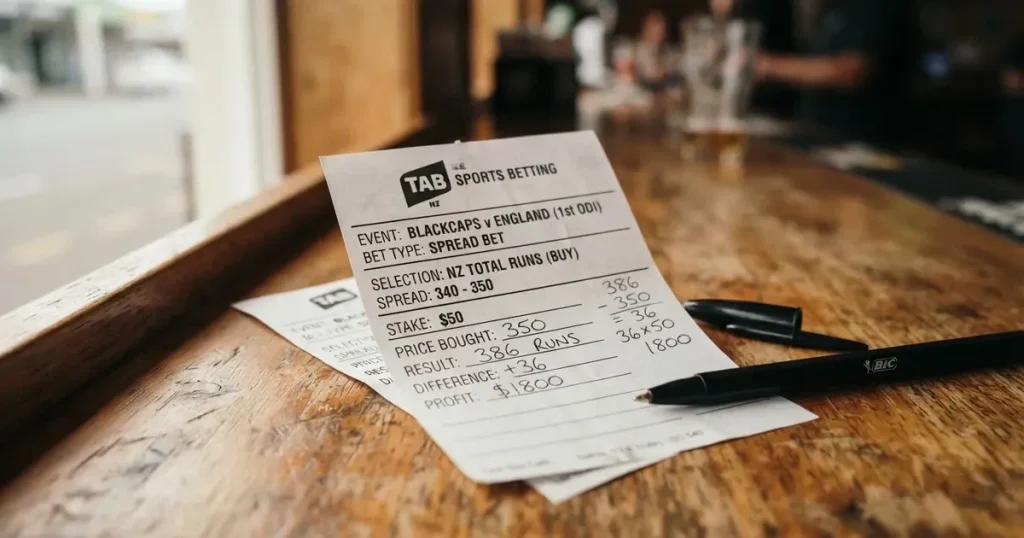
A bettor who searches for “spread betting in New Zealand” almost always lands on the same wall: there is no New Zealand-licensed spread-betting firm. The Racing Industry Act 2020, as amended on 28 June 2025, leaves only one provider lawfully offering racing and sports betting to people in New Zealand — TAB NZ, online as TAB and as Betcha — and spread betting and exchange betting sit outside TAB NZ’s published definition of sports betting. The wager itself is widely understood in other markets, mostly UK sports spread betting and the North American point spread, and New Zealanders meet it through offshore books and through coverage of overseas leagues. This page explains how spread betting actually works, how a margin eats into a market’s prices, and what a New Zealand player can and cannot legally do today.
*Current as of October 30, 2026. Licence status verified against the Racing Industry Act 2020 (section 74AAA, in force 28 June 2025) and the Department of Internal Affairs’ statement to unlicensed providers.*
Where spread betting actually runs
What a spread is, in plain terms
A spread bet does not ask “win or lose” the way a fixed-odds wager does. It asks how far the result lands from a quoted band, and the payoff is the stake multiplied by the number of points of difference. Profit or loss equals the stake times the points the result is away from the bet level — losses are not capped by the stake, so a wrong way bet can cost several times what was put down.
There are two products people confuse under the same name. UK-style sports spread betting is run by firms like Spreadex and Sporting Index; the book quotes a range such as 340–350 runs for a cricket team’s innings, the bettor picks a level inside or outside that range, and the payoff is the difference in units multiplied by the stake. North American point-spread betting is the version that shows on NFL and college football lines: the favourite lays points, the underdog gets them, the price is the standard 10/11 (-110 in American odds, around 1.91 in decimal), and the wager either wins at that price or loses its stake.

The two feel related, and they are, but they pay out differently. A North American point-spread bet loses the stake on a loss and returns roughly 1.91 times the stake on a win. A UK-style spread bet of $10 at 350 on a cricket total pays $10 × 50 = $500 if the team scores 400 and charges $10 × 50 = $500 if the team scores 300. The same headline bet, two completely different risk profiles.
Where it came from
The North American point spread was devised in the 1940s by Charles K. McNeil, a Connecticut mathematics teacher who became a Chicago bookmaker, as a way to make uneven football matchups interesting to bet on. UK sports spread betting followed in the 1980s, built on the financial-spread-betting model that had itself been adapted from stock-market trading. The financial version — bets on whether an index, a currency pair or a commodity will finish above or below a quoted level — is the original; sport and other markets were bolted on once the mechanism existed.

That origin matters because it explains why losses are uncapped. A financial spread bet is leveraged: collateral is typically 5–10% of total exposure, and the bettor can lose several times the original margin if the move is against them. Sports spread betting borrowed the leverage without quite borrowing the same risk controls, and the result is a product where a single bad weekend on a cricket or a goals market can run well past what the punter put down.
Why New Zealand is different
Section 74AAA of the Racing Industry Act 2020 — inserted by the Racing Industry Amendment Act 2025 and in force from 28 June 2025 — bars any person other than TAB NZ from offering racing betting, sports betting, or “other racing or sports betting” to a person in New Zealand, regardless of where that person is resident or incorporated. TAB NZ’s published definition of sports betting covers fixed-odds and pool (tote) bets on racing and sporting events; spread betting and exchange betting are not part of it. The Department of Internal Affairs told offshore providers serving New Zealand to withdraw with immediate effect when the section came into force. There is no licence to apply for, because the statute leaves no room for one, and there is no bookmaker register for the same reason.
For a New Zealand player that creates an unusual position. UK sports spread betting firms are accessible in the sense that nothing geo-blocks their websites from New Zealand, but accepting a wager from a New Zealand customer is the very thing section 74AAA prohibits. Section 19(4) of the Gambling Act 2003, inserted in 2025, makes clear an individual cannot be convicted simply for placing a bet with an offshore operator that is itself in breach of section 74AAA; the statute targets the operator. New Zealand bettors who want to use a Spreadex-style product must have to weigh the question of whether they are dealing with a lawful counterparty at all, because the New Zealand complaints framework and harm-minimisation tools do not reach the offshore book.
The mechanics, step by step
Buying and selling the spread
In UK sports spread betting the book publishes two prices — the lower edge and the upper edge of a band — and the bettor decides whether the real result will fall above or below that band. Buying means betting that the result will be higher than the top of the quoted spread; selling means betting it will be lower than the bottom. The bet level the punter names is the number of units they will win or lose per dollar staked for every point of difference between the result and the level.
The cricket example is the cleanest illustration. A spread of 340–350 runs is published for a team’s innings. The punter buys at 350 — that is, bets the team will score more than 350. The team scores 400, which is 50 runs above the bet level, so the punter wins 50 units × stake; if the stake was $10, the payout is $500. The team instead scores 300, which is 50 below the level, and the punter loses 50 units × stake; the same $10 stake costs them $500.
The maths is the same on the sell side. If the punter sells at 340, betting the team will score fewer than 340, a score of 300 wins 40 units × stake; a score of 400 loses 60 units × stake. Two punters can sit on opposite sides of the same quoted spread and both believe they have made a clever bet; the bookmaker’s edge is built into the gap between the buy and sell prices, which is wider than the punter usually appreciates on first encounter.
How a North American point spread pays
A point-spread bet is structured differently. The book quotes a line — New England Patriots −3.5, for example — and the price, almost always 1.91 in decimal odds (or −110 in American), which is the price the punter pays to take either side. The favourite has to win by more than 3.5 points for a bet on them to win; the underdog wins the bet if they lose by 3 points or fewer, or win outright.
A result landing exactly on the spread is a push, and the stake is refunded. This matters on whole-number lines — a Patriots −3 line, with the Patriots winning by exactly three, returns the stake rather than either side winning. Most professional lines use half-points to avoid the push, but the rule is built into the product.
What a margin does to a price
Every bookmaker’s quoted odds carry a margin — the slice of every dollar wagered that the book expects to keep. The arithmetic is straightforward. For a two-outcome market priced at decimal odds o₁ and o₂, the payout share is 1 ÷ (1/o₁ + 1/o₂); the margin is 1 minus that payout share. The two share one dollar between them, and the book keeps the difference.
A flat two-way market at 1.90 / 1.90 is the canonical example. The payout share is 1 ÷ (1/1.90 + 1/1.90) = 1 ÷ 1.0526 = 0.95, so the margin is 0.05, or 5%. Put differently: of every dollar bet on this market across both outcomes, 95 cents comes back to bettors as winnings and 5 cents stays with the book on average. That 5% is the cost of using this bookmaker instead of one with tighter lines, and it compounds across accumulators because each leg carries its own margin.
Real markets are rarely this clean. The favourite–underdog pairing is usually something like 1.45 / 3.10, and the margin on that pair sits higher because the favourite’s shorter price means a small absolute shift eats more of the implied probability. Three-way markets — the 1/X/2 line on football — carry more margin again, because three implied probabilities have to add up to more than 100%. A book quoting 2.10 / 3.40 / 3.60 on a balanced match has an overround of about 7% before any round trips in the price’s display, and that 7% is what the punter is paying for the privilege of betting on the draw.
Spread betting’s margin is more variable. A UK sports spread firm quotes a spread it expects to land inside, with a make-up on each side that varies by market and by event. The 340–350 cricket spread implies the book expects something close to a 345 average, and the gap between 340 and 350 is where the margin lives — wider on events the book is less sure of, tighter on events it has priced tightly. North American point spreads at the standard 1.91 carry roughly a 4.5% margin built into both sides, which is why a sharp bettor hunting for value usually looks at the price first and the line second.
Spread betting in New Zealand’s sports
Which sports actually carry a spread
UK sports spread betting runs deepest on the high-scoring sports where a number of points of difference is meaningful: cricket (total runs in an innings), football (total goals, corners, bookings), rugby (total points), and horse racing (winning distances, beaten lengths, the race’s finishing time). North American point spreads run on the four major US leagues (NFL, NBA, MLB, NHL), college football and basketball, and on most professional football leagues worldwide through licensed US books.
In New Zealand the published betting menu from TAB NZ is fixed-odds and pool (tote) on racing codes — thoroughbred, harness, and greyhound until greyhound racing closes in stages from 1 August 2026 — and on major sports competitions across both codes of rugby, NRL, football, cricket, basketball, tennis, and the major US leagues. Live betting is listed in the TAB NZ apps; whether a particular in-play market is offered depends on TAB NZ’s product rules, not on a statute, and the rules are published in the betting rules document rather than the Racing Industry Act. Spread betting, by contrast, is not on the menu because TAB NZ’s statutory remit does not extend to it.
For a New Zealand punter who wants to bet the spread on the All Blacks, the Warriors, the Black Caps or the Melbourne Cup, the realistic routes are an offshore book that takes fixed-odds bets with a handicap line or an outright line, or a UK sports spread firm where account opening is still possible. The Racing Industry Act does not require New Zealand-licensed books to offer spread betting; it requires that no one other than TAB NZ offers racing or sports betting in New Zealand, which is why the offshore book route is the path that exists, and why that route carries the section 74AAA caveat the earlier section of this page set out.
The handicap and line markets that look like spread betting
A New Zealand punter looking through the TAB NZ app or through an offshore book will find several bet types that feel adjacent to spread betting without being it. Line betting, also called handicap betting, gives one side a points head-start. The All Blacks −6.5 at 1.91 means the All Blacks have to win by seven or more for the bet to pay; the opponent +6.5 means the opponent can lose by six or fewer, or win, for the bet to pay. The price is fixed and the payout is the stake multiplied by the odds if the bet lands.
Same-game multis combine legs from one match into a single price. A multi on the All Blacks to win, the total to go over 47.5, and a try-scorer to score at 5.50 multiplies the three legs into one price, and the punter either lands all three or loses the stake. Quaddies and Big6 on the racing side work the same way across four or six races. None of these is a spread bet; the payoff is fixed and the loss is capped at the stake. The feeling of being able to “bet on the spread” is satisfied by these products, but the risk profile is closer to a fixed-odds wager than to a UK sports spread.
The Top 10: who actually takes New Zealand bets
The comparison shelf
The page covers ten platforms in the order research sets out — TAB NZ’s two online brands first, then eight offshore books a New Zealand punter is likely to meet. The first two are the only lawful route; the rest are not licensed in New Zealand, are not covered by a New Zealand complaints framework, and exist on this page because a reader looking at spread betting in New Zealand will run into them in the wild. None of the offshore brands is recommended; the shelf exists so the reader can recognise what they are looking at.
| Brand | New Zealand status | What the operator’s own terms state |
|---|---|---|
| TAB | One of the two online brands of TAB NZ; the only provider lawfully offering racing and sports betting to people in New Zealand under section 74AAA of the Racing Industry Act 2020 (in force 28 June 2025) | Fixed-odds and tote bets on racing and sports; live betting in the app; deposit limits, time-outs and self-exclusion built into the account; the free Gambling Helpline 0800 654 655 and text line 8006 listed inside the app |
| Betcha | One of the two online brands of TAB NZ; same lawful status as TAB under section 74AAA | Fixed-odds and tote bets; a daily Toolbox with odds boosts and insurance-style refunds on losing bets; a Bet Social section with chat, follow and shared bet/pool features; a Playbook section with tips and match analysis |
| Rabona | Not licensed in New Zealand; the named Curaçao licence gives no right to take bets from people in New Zealand | The brand launched 23 December 2019 as the sixth Soft2Bet sportsbook; specific sportsbook and welcome-package terms are not published |
| Sportaza | Not licensed in New Zealand; the named Anjouan licence (ALSI-202606064-FI2) gives no right to take bets from people in New Zealand | Cash out before an event or market is finalised; Bet Builder with the rule that one void leg voids the whole slip; multiples; Asian lines; interval markets in 1, 5, 10 or 15 minute ranges |
| RTbet | Not licensed in New Zealand; the named Curaçao licence gives no right to take bets from people in New Zealand | Cash out before an event or market is finalised, with the cash-out amount fixed at the moment it is accepted; the operator does not guarantee that the feature is always available |
| Telbet | Not licensed in New Zealand; the operator names no licence that applies in New Zealand | Self-described as a crypto casino and sportsbook; the operator’s Russian-language site shows a welcome package of 200% up to 1 BTC plus 50 free spins alongside a 5 USDT free-bet token, with English-site content varying |
| 22Bet | Not licensed in New Zealand; the named Curaçao licence (8048/JAZ) under TechSolutions Group N.V. gives no right to take bets from people in New Zealand | Single bets, accumulators, systems and chains; live betting with real-time odds and score updates; full product breadth not publicly detailed |
| Rooster | Not licensed in New Zealand; the named Tobique Gaming Commission e-gaming licence (No. 0000002) under Novatrix SRL (Costa Rica, registration 3-102-893958) gives no right to take bets from people in New Zealand | Operated by Novatrix SRL, a Costa Rica company; the licence cited is an e-gaming licence, not a New Zealand betting permit |
| Spinbara | Not licensed in New Zealand; the operator names no licence that applies in New Zealand | First deposit bonus of 100% up to EUR 100 and a sport crypto welcome bonus of 100% up to 200 USDT on the English site, alongside a separate casino welcome bonus |
| Thunderpick | Not licensed in New Zealand; the named Curaçao licence (OGL/2024/677/0722) under Paloma Media B.V. (company number 146988) gives no right to take bets from people in New Zealand | Crypto esports betting and casino product |
The two rows above the line and the eight below it are not the same kind of entry. TAB and Betcha are the same operator group run by Entain under a 25-year agreement signed in 2023, with Entain taking 50% of gross profits and at least $150m a year going to TAB NZ for the first five years, plus a one-off $100m payment to the racing sector; they are not rivals and must not be read as competing for the same bet. Every other entry below the line is unlawful for the operator to take from a New Zealand customer, which is the reason a New Zealand punter looking for spread betting ends up reading about them anyway.
TAB and Betcha, the lawful pair
TAB is the older of the two brands, the one most New Zealand punters already know from retail outlets and the original app. The operator’s own terms cover Win, Place, Each Way, Quinella, Exacta, Trifecta, First Four, Double, Treble, Daily Double, Running Double, Quaddie, Big6 and the Same Game Multi; live betting sits inside the same app; deposit limits, time-outs and self-exclusion are operator-level harm-minimisation tools rather than statute, but they are published and they apply across TAB NZ’s brands.
Betcha is the newer online sister brand of TAB NZ, pitched at a more social, mobile-first audience. Betcha offers a daily Toolbox with odds boosts and insurance on losing bets, a Bet Social section for chat and shared bets, and a Playbook with tips and match analysis. The two brands share an account-level exclusion: a punter who self-excludes from TAB is self-excluded from Betcha, and vice versa. TAB NZ’s Problem Gambling Levy contribution — 0.74% in force from 1 July 2025 to 30 June 2028 — funds treatment and harm-minimisation services; the levy is on the operator, not on the player.
For a reader looking for spread betting specifically, neither brand offers it. The honest framing is that TAB NZ covers fixed-odds and tote on racing and sports, with the same-game multi and live betting layered on top, and that spread betting as a product is not part of the lawful menu in New Zealand.
The offshore eight, in their own terms
The remaining eight brands sit on this page because a New Zealand punter looking for spread betting or for a wider menu will meet them online, and the comparison is incomplete without naming what each actually offers. None of them is licensed in New Zealand. None is covered by a New Zealand complaints framework. None has a verified New Zealand address requirement for account opening. The Department of Internal Affairs’ published warning is that overseas operators may be in jurisdictions with minimal consumer safeguards, may not return unspent credits, and may not pay out large wins.
Rabona launched as the sixth Soft2Bet sportsbook on 23 December 2019. Sportaza’s terms specifically mention cash out before an event or market is finalised, a Bet Builder where one void leg voids the whole slip, multiples, Asian lines, and interval markets in 1, 5, 10 or 15 minute ranges. RTbet’s terms specifically mention cash out, with the cash-out amount fixed at the moment the punter accepts it and a clause that the feature is not always available. 22Bet lists singles, accumulators, systems and chains, plus live betting with real-time odds and score updates. Rooster is operated by Novatrix SRL in Costa Rica under a Tobique Gaming Commission e-gaming licence, and the cited licence is for e-gaming, not for New Zealand betting. Spinbara carries a sport and casino welcome package on its English site. Thunderpick is a crypto esports betting and casino operation under a Curaçao licence.
Telbet describes itself as a crypto casino and sportsbook; its Russian-language welcome package of 200% up to 1 BTC plus 50 free spins alongside a 5 USDT free-bet token is the clearest specific in this set, and the English site carries different content. Ivibet carries a sportsbook menu that lists Sports Betting, Live Betting, Racing, Forecasts, Boosted Odds and Copy Bets; BillyBets offers three odds formats (Decimal, American, Fractional). RoyalistPlay, also under Novatrix SRL on the same Tobique e-gaming licence, is likewise outside the featured set.
A reader using this shelf to compare products is advised to read the right-hand column as what each operator’s own terms say, and the middle column as the New Zealand position, which is the same for all eight: unlawful for the operator to serve a New Zealand customer, no New Zealand complaints route, no New Zealand harm-minimisation framework reaching the account.
What the law actually says
Section 74AAA and what it covers
The Racing Industry Amendment Act 2025 inserted section 74AAA into the Racing Industry Act 2020, and the section took effect on 28 June 2025. The text prohibits any person other than TAB NZ from offering racing betting, sports betting, or “other racing or sports betting” to a person in New Zealand. The phrase “other racing or sports betting” was the change that brought spread betting and exchange betting inside the prohibition; under the prior law the prohibition covered racing betting and sports betting specifically, and the broader phrase closes the door on products that look like sports betting but were not on the original list.
The statute does not require TAB NZ to seek a licence, because the section grants the monopoly rather than licensing it. There is no bookmaker register because there is no licensing regime to populate one. The Department of Internal Affairs monitors compliance under section 92A of the same Act, and told providers serving New Zealand to withdraw with immediate effect when the section came into force. The penalty for breaching section 74AAA is not stated in the section itself, and no prosecution of an offshore bookmaker has been found.
Section 19(4) of the Gambling Act 2003, also inserted in 2025, makes clear that an individual cannot be convicted simply for placing a bet with an offshore operator that is itself in breach of section 74AAA. The framing matters: New Zealand law targets the operator and warns the player, rather than prosecuting the player. The Department of Internal Affairs’ published warning to players is that overseas operators may be in jurisdictions with minimal consumer safeguards, may not return unspent credits, and may not pay out large wins. None of this is tax advice and the page does not offer any; for the player’s own tax position, Inland Revenue guidance says recreational gambling winnings are generally not taxable, with a person who bets as a business as a separate case.
What may be bet on, and what may not
TAB NZ takes fixed-odds and tote bets on the racing codes and on the sports competitions listed in its published programme. Thoroughbred, harness and greyhound racing are covered; greyhound racing closes in stages from 1 August 2026, after which TAB NZ will not take greyhound bets and offshore operators may not either. The sports programme runs across the major New Zealand and Australian leagues and across the major US leagues; live betting is listed in the TAB NZ apps.
What TAB NZ does not take is spread betting or exchange betting. The statute leaves those products out, the operator’s published product list leaves them out, and the consequence is that a New Zealand punter wanting either product is dealing with an offshore counterparty or not betting at all. The Online Casino Gambling Act 2026, which licenses online casino gambling, does not extend the betting monopoly into casino product and does not change the position on spread betting; TAB NZ winning the right to apply for a casino licence is a separate matter from TAB NZ’s existing racing and sports monopoly. Bets on politics and novelty markets are not available.
What the player is and is not told
The Department of Internal Affairs’ published position is that an offshore bookmaker serving a New Zealand customer is breaking New Zealand law. The player, by section 19(4), is not liable for prosecution for placing the bet. The Department also warns players of the risks of dealing with an offshore counterparty. The combined framing — unlawful for the operator, not unlawful for the player, with a published risk warning — is the honest framing the page takes, and the page does not put a gloss on it either way.
The honest framing for a comparison is that TAB NZ and Betcha are the only lawful route, with New Zealand harm-minimisation tools, regulator oversight and a complaints framework; offshore is unlawful for the operator to serve a New Zealand customer, with no New Zealand complaints route and with the Department of Internal Affairs’ stated risks. Neither is “the safe choice” by default, because the two are not the same kind of choice. A New Zealand punter who wants spread betting has a narrower decision than the offshore shelf suggests, and the wider shelf exists for context rather than as a menu.
Staying in control of the bet
What TAB NZ publishes
TAB NZ’s app lists three harm-minimisation tools as standard: deposit limits, time-outs, and self-exclusion. A punter who sets a deposit limit cannot deposit above the limit until the cooling-off or the review window the operator publishes; a punter who takes a time-out cannot log in and bet for the duration; a punter who self-excludes cannot open a new TAB NZ account for the period the operator sets, and the exclusion applies across TAB NZ’s brands. The app also lists the free Gambling Helpline on 0800 654 655, the text line 8006, and Safer Gambling Aotearoa as the published help routes.
TAB NZ contributes to the Problem Gambling Levy at 0.74%, in force from 1 July 2025 to 30 June 2028; the levy funds treatment and harm-minimisation services. There is no single national online-betting exclusion register for betting: the register the Online Casino Gambling Act 2026 will require is for online casinos only, and it does not extend to TAB NZ or Betcha accounts. A punter who self-excludes from TAB NZ is self-excluded across the operator’s own brands and not from another operator; offshore books operating outside New Zealand do not pick up the exclusion.
What offshore books publish, and where it stops
The eight offshore books named earlier carry their own harm-minimisation tools — most publish deposit limits, time-outs and self-exclusion as standard, and most publish a problem-gambling help line. None of those tools is connected to the New Zealand framework. A punter who self-excludes from one offshore book can open an account with another the same day, and there is no central register on either side of the bet to share the exclusion. The Department of Internal Affairs’ warning to players is the published position on this gap: overseas operators may be in jurisdictions with minimal consumer safeguards, and a punter who has self-excluded locally may still find the offshore route available.
The page’s position on harm minimisation is the operator’s published tools plus the New Zealand help routes for the lawful side, and the honest description of what is missing for the offshore side. A reader who needs the New Zealand help routes has them listed inside the TAB NZ app; a reader who is using an offshore book needs to know the New Zealand routes still apply and that the offshore book cannot connect to them.
The advertising frame
The Advertising Standards Authority’s Gambling Advertising Code applies to betting advertisements in New Zealand. The Code requires that ads must not target children (under 14) or young people (14 to under 18), judged by context, appeal and the expected audience, with 25% or more of the audience counting as significant where accurate audience data exists. Ads must not encourage harm and must be truthful with terms available. The Code applies to all betting advertising, and the Department of Internal Affairs reads the section 74AAA prohibition as covering promoting or taking such bets for another operator.
The page does not advertise any of the brands named above and does not invite readers to sign up with any of them. The offshore brands exist on the page for context, because a New Zealand reader looking for spread betting will meet them in the wild; the lawful brands exist because they are the lawful route.
The wager itself, settled
How a winning bet pays out
For a fixed-odds bet the arithmetic is the standard one. The return on a winning bet is the stake multiplied by the decimal odds; the net profit is the stake multiplied by (odds minus one minus, depending on how the book phrases it). A $10 bet at decimal odds 2.50 returns $25 — $10 of which is the original stake and $15 of which is net profit. For a multi, the legs multiply into a single price; a three-leg multi at legs of 1.80, 2.20 and 1.95 multiplies to 7.722, and a $10 stake returns $77.22 on a win.
For a spread bet the arithmetic is the difference. The punter’s profit or loss is the stake multiplied by the number of points (or units, or runs, or goals) the result is away from the bet level. The earlier cricket example gives $500 either way on a 50-unit gap at $10 a unit. The same maths applies to a football total or a rugby point spread; the unit is whatever the book quotes, and the spread’s width determines the swing.
How the margin shows up
The margin is the slice of every dollar wagered that the book expects to keep across a market. A two-way market priced at 1.90 / 1.90 has a 5% margin, as the earlier section calculated. A three-way football market at 2.10 / 3.40 / 3.60 has a 7% overround before rounding. The book’s quoted odds imply probabilities that add up to more than 100%, and the gap is the margin.
A book’s margin is the cost of using that book instead of one with tighter lines. A 5% margin means a $100 turnover returns $95 on average across the two sides of the market; a 7% margin on a three-way market means $93 returned on average. Across an accumulator the per-leg margin compounds, and a five-leg multi at markets each carrying a 5% margin carries a combined edge closer to 23% than to 25% but well above the single-market 5%. The punter pays the margin on every bet, and the only way to reduce the cost is to find books that quote tighter lines on the markets they bet.
What a spread bet’s margin looks like
A UK sports spread firm’s margin is harder to see than a fixed-odds book’s, because the firm quotes a spread rather than a price. The 340–350 cricket spread implies the firm expects the innings to land at about 345, with a margin built into the distance between 340 and 350. A wider spread means a bigger margin; a tighter spread means the firm is more confident in its line and is willing to take less edge. The punter pays the spread’s width on every wager, and the comparison across firms is about which one publishes the tightest spread on the market the punter wants to bet.
The North American point spread at 1.91 on both sides carries roughly a 4.5% margin. Some books offer reduced juice on big games — 1.95 instead of 1.91 — which trims the margin to about 2.5% and is one of the few ways a sharp recreational bettor can find a structural edge. The New Zealand reader will not find either product on the TAB NZ menu; the menu is fixed-odds and tote, and the comparison is between TAB NZ’s quoted margins and those of offshore books a reader might use.
Closing the comparison
Where the page lands
The page’s position is straightforward: TAB NZ and Betcha are the only lawful route for a New Zealand punter wanting to bet on racing or sport, and spread betting is not on that route. The eight offshore books named are unlawful for the operator to serve a New Zealand customer, which is not the same as unlawful for the player but is the reason a New Zealand punter looking at them needs to know what the operator is and is not offering, and what the New Zealand framework is and is not reaching.
A reader who wants spread betting specifically is looking at one of three things: a North American point spread on the NFL or college football, which most offshore books in the comparison offer as a fixed-odds product rather than a spread product; a UK sports spread firm like Spreadex, which accepts bets from customers in jurisdictions where the firm is licensed and where spread betting is regulated; or a financial spread bet on an index or a currency pair, which is a different product category and not on this page. None of the three is available through the lawful New Zealand route, and the page’s position is that the lawful route is the one the New Zealand reader is advised to default to unless they have a specific reason to do otherwise.
What the lawful route looks like in practice
TAB NZ’s published programme covers the major New Zealand and Australian leagues and the major US leagues; live betting sits in the app; the same-game multi lets a punter combine legs from one match; quaddies and Big6 run across the racing codes. The harm-minimisation tools are inside the app, the help lines are inside the app, and the operator’s levy contribution funds treatment services. The product set is narrower than a global offshore book offers, and the operator’s margin on the markets it does offer is the published cost.
A New Zealand punter who wants the spread product on a market TAB NZ does not offer has, in 2026, no lawful way to get it. The honest page does not pretend otherwise.
Frequently asked questions
How does spread betting work in football?
A UK sports spread betting firm quotes a range — say 1.6–1.8 goals for a Premier League match — and the punter buys or sells that range. Buying at 1.8 means betting the total goals will exceed 1.8; selling at 1.6 means betting it will fall short. The payoff is the stake multiplied by the gap between the result and the bet level. A North American point spread on football works like fixed-odds with a handicap: a −3.5 favourite wins the bet if it wins by four or more, with the standard price around 1.91 in decimal odds.
How do you bet against the spread?
“Betting against the spread” usually means taking the underdog on a North American point spread: a team getting +6.5 points at 1.91 wins the bet if they lose by six or fewer, or win outright. In UK sports spread betting, “selling” the spread is the analogous move: the punter bets the result will fall below the bottom of the quoted range, and wins the stake multiplied by the gap on the lower side.
How do you bet against the spread in football?
The mechanics are the same as in any other sport with a North American line: take the points with the underdog at the standard 1.91 price, with the bet winning if the underdog covers. On the UK sports spread side, selling the total goals or selling the corners market is the football-specific version, and the punter’s profit or loss swings with how far the result is from the quoted level.
Which bookmaker may lawfully take sports and racing bets in New Zealand?
TAB NZ is the only provider lawfully offering racing and sports betting to people in New Zealand, online as TAB and as Betcha, under section 74AAA of the Racing Industry Act 2020, in force since 28 June 2025. There is no licence to apply for and no bookmaker register, because the statute leaves no room for another provider. Offshore operators serving New Zealand customers are breaking New Zealand law; the Department of Internal Affairs told such providers to withdraw with immediate effect when section 74AAA came into force.
How is the return on a bet worked out from the stake and the odds?
For a fixed-odds single the return on a winning bet is the stake multiplied by the decimal odds; the net profit is the stake multiplied by (odds − 1). A $10 stake at decimal odds 2.50 returns $25, of which $15 is net profit. For a multi the legs multiply into a single price — three legs at 1.80, 2.20 and 1.95 combine to 7.722, and a $10 stake returns $77.22 on a win. For a spread bet the return is the stake multiplied by the gap between the result and the bet level, and the loss on a wrong-way bet is the stake multiplied by the same gap on the other side.
What is the bookmaker’s margin and how can it be seen in the odds?
The margin is the slice of every dollar wagered that the book expects to keep. For a two-way market priced at decimal odds o₁ and o₂, the payout share is 1 ÷ (1/o₁ + 1/o₂) and the margin is 1 minus that payout share. A flat 1.90 / 1.90 market carries a 5% margin; a 1.45 / 3.10 favourite-underdog pair carries more. Three-way markets carry more margin again, because three implied probabilities add up to more than 100%. The margin compounds across accumulators, because each leg carries its own edge.
Tips & strategy – leaguebetsnz
Content created by the «leaguebetsnz» team
