
Score Betting in New Zealand 2026: The Choices That Actually Exist
 Available in US
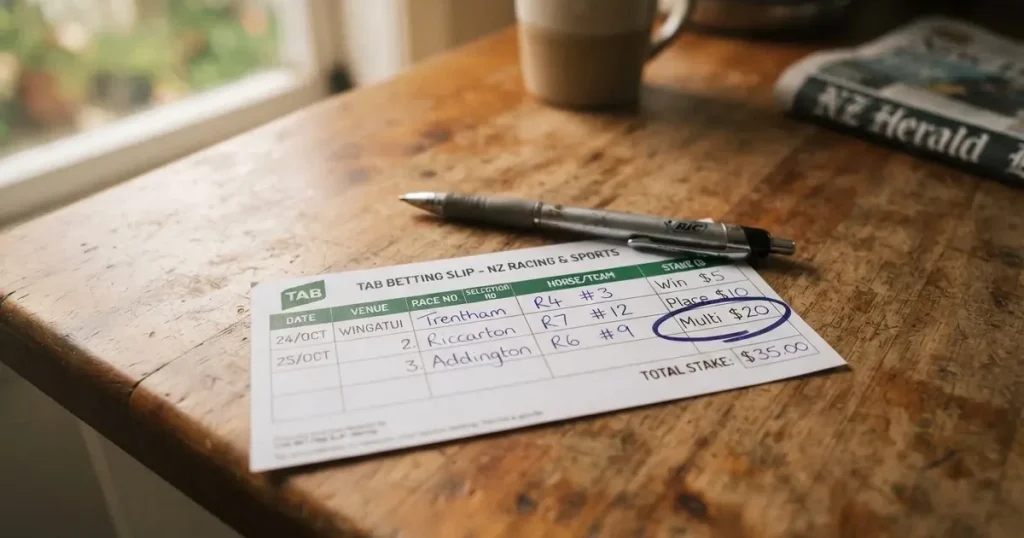
Anyone searching for “score betting in New Zealand” arrives at a thinner market than they expect. There is no choice of bookmaker on the same shelf. Since an amendment to the Racing Industry Act 2020 took effect on 28 June 2025, TAB NZ and its online sister brand Betcha are the only operators allowed to take online sports and racing bets in New Zealand, and the Department of Internal Affairs told unlicensed providers to withdraw with immediate effect. The score-betting idea itself — picking a final score, a goal total, or both sides to find the net — is the easy half. The harder half is knowing which platforms can legally offer it, what each one costs to use, and which reader each path actually suits.
Current as of October 30, 2026 against the Racing Industry Act 2020 (section 74AAA, in force from 28 June 2025) and the Department of Internal Affairs guidance.
What Score Betting Actually Is
Score betting is the umbrella term for wagers whose outcome is a points or goals number rather than the binary question of who wins. Three shapes turn up most often in the New Zealand market and in the offshore books a Kiwi punter still meets through word of mouth.

A correct-score bet picks the exact final score of a match. A 2–1 home win, a 1–1 draw, a 3–0 away upset — the bet only pays out if the predicted scoreline lands exactly. Because the outcome space is wide (any plausible combination in regulation time), the prices are long and the strike rate is short.
An over/under or totals bet picks whether the combined score finishes above or below a number set by the bookmaker — typically 1.5, 2.5, 3.5 or 4.5 goals in football. The market is two-way, prices sit close to even money, and the reader is essentially making a probability call about how open the match will be.
A both-teams-to-score bet asks a different question: will each side manage at least one goal, regardless of who wins. It does not depend on the total or the margin, only on whether each team breaks through. Prices usually sit just below evens because a goalless draw or a one-sided shutout kills the bet.
The three forms share a feature the reader cannot afford to lose sight of. Every price the bookmaker quotes already has the operator’s margin baked in, and a margin on a long-shot market is harder to see and harder to beat than one on a 1X2 match result. A 2–1 correct-score line at 8.00 does not mean the bookmaker thinks the chance is one in eight. It means the chance is one in eight after the operator has taken its cut.
Which Sports and Tournaments Carry Score Markets
Score markets are not evenly distributed across sport, and a New Zealand punter will meet them in three places first.

Football carries the deepest correct-score and both-teams-to-score coverage. From the English Premier League and the UEFA Champions League down to the A-League and the OFC Pro League, every major fixture publishes a full correct-score grid (1–0, 2–0, 2–1, 3–0, 3–1, 3–2 and so on, plus the away variants and draw lines), an over/under ladder on the total, and a both-teams-to-score toggle. Where the Premier League is the headline competition for which markets open, the same Group stage carries the same grid for European nights.
Rugby league and rugby union run their own version. The score market is usually framed as a margin or handicap rather than a precise number — the All Blacks winning by 1–12, 13–18, 19+ — and an over/under on the total match points. Correct-score grids in rugby are less common than in football because the scoring bands are wider and the in-play variance is larger.
Basketball, American football and ice hockey are deep totals markets. The over/under on total points is the workhorse line; correct-score grids exist for the NBA and NFL but pay so long that they are more curiosity than working tool.
Cricket, tennis and the racing codes (thoroughbred, harness, greyhound) are not score markets in this sense. Cricket has a runs line, tennis has a games line and a set score, racing has a finish position — none of which is a “score” in the football-goals sense, and the page treats them as adjacent markets rather than as score betting proper.
Score-Betting Choices in New Zealand
The ranking that follows is not a leaderboard of who is best at odds or who pays fastest. New Zealand is not that kind of market. Two of the ten entries below are lawful for a person in New Zealand to bet with. The other eight are not. They are listed because a New Zealand punter meets them, sees them advertised, or hears about them from mates, and because the more useful question than “who is number one” is “which path suits this punter at all”. The ranking orders lawful options first, then ranks the offshore options against the same criteria, with each entry’s licence status stated plainly.
The comparison table at the end of this section sets each brand’s New Zealand status against what its own terms say about the score-bet subject — the two columns that decide whether the path is open to a New Zealand reader at all.
| Brand | New Zealand status | What the operator’s own terms state on the score-bet subject |
|---|---|---|
| TAB | TAB NZ brand — lawful for New Zealand players | Fixed-odds and same-game multis across racing and sports, including rugby union and rugby league; Mega Multi bonus of up to $50 in Bonus Cash on a multi of 4+ legs that misses by a set number of legs |
| Betcha | TAB NZ brand — lawful for New Zealand players | Daily Toolbox with odds boosts and insurance on losing bets, Playbook with tips and match analysis, plus the same TAB NZ sports and racing markets under a younger-looking app |
| Roobet | Not licensed in New Zealand | Curaçao-licensed sportsbook and casino; no score-bet specifics published in the terms reviewed |
| Glorion | Not licensed in New Zealand | Sportsbook with no published New Zealand licence; support by live chat and email, 18+ only |
| Golden Panda | Not licensed in New Zealand | Dedicated Sports Terms including fixed-odds, combo bets, Bet Builder, live scoreboards and stake and odds limits |
| Sportaza | Not licensed in New Zealand | Anjouan-licensed; cash out before settlement, Bet Builder (a void leg voids the slip), multiples, Asian lines, and interval markets in 1, 5, 10 or 15 minute windows |
| RoyalistPlay | Not licensed in New Zealand | Tobique-licensed sportsbook; six odds formats including European and Hong Kong; English-NZ site version available |
| Telbet | Not licensed in New Zealand | Crypto casino and sportsbook; sports terms reviewed do not detail score-bet coverage |
| Rabona | Not licensed in New Zealand | Curaçao-licensed Soft2Bet sportsbook launched December 2019; sports terms reviewed do not detail score-bet coverage |
| Winz.io | Not licensed in New Zealand | Anjouan and Tobique-licensed; sports terms reviewed do not detail score-bet coverage |
Two patterns show immediately. The first is that the two lawful brands are not rivals. They share a back end, a betting engine, and an odds feed — TAB is the established face, Betcha is the younger social wrapper with a daily Toolbox and a Playbook. A punter choosing between them is choosing an interface and a feature mix, not choosing between two bookmakers. The second pattern is that the offshore books offer broader feature lists on paper — bet builders, six odds formats, interval markets — but the breadth is irrelevant in New Zealand. The Department of Internal Affairs warns that offshore operators may be in jurisdictions with minimal consumer safeguards, may not return unspent credits, and may not pay out large wins, and the absence of a New Zealand complaints route is the part that bites when something goes wrong.
How Score Betting Sits Inside New Zealand Law
The structure that decides who can take a bet in New Zealand is short and recent. The Racing Industry Act 2020 establishes TAB NZ as the provider of racing and sports betting. The Racing Industry Amendment Act 2025 inserted section 74AAA, which came into force on 28 June 2025: no person other than TAB NZ may offer racing betting, sports betting or other racing or sports betting to a person in New Zealand, regardless of where that person is resident or incorporated. The Department of Internal Affairs told providers serving New Zealand to withdraw with immediate effect. There is no licensing route for another bookmaker, and there is no licence register for betting, because there is only one lawful operator.
A few lines have to be drawn plainly because they are easy to muddle.
TAB and Betcha are not two competing bookmakers. They are the two online brands of TAB NZ, run by Entain under a 25-year partnership signed in 2023 that gives Entain a 50/50 share of gross profits, with at least $150m a year going to TAB NZ for the first five years. Entain also pledged a one-off $100m payment to the racing sector. The partnership is the engine; the two front-ends are the shopfronts.
A New Zealand punter who bets with an offshore book is not, on the published record, committing an offence. Section 19(4) of the Gambling Act 2003 (inserted in 2025) says an individual may not be convicted for placing a bet with an offshore betting operator in breach of section 74AAA; no source states a penalty for a player. The law targets the operator that serves New Zealand and puts liability there. The honest framing is that TAB NZ and Betcha are the only lawful option, with New Zealand harm-minimisation tools, regulator oversight and a complaints framework; offshore means the operator is in breach, there is no New Zealand complaints route, and the Department of Internal Affairs has stated the risks a player takes on.
The law does not geo-block offshore websites. New Zealand does not run a site-blocking regime for sportsbooks, so a Kiwi with a credit card and a VPN can still reach an offshore brand. The fact that it is reachable is not the same as the fact that it is lawful. The Department of Internal Affairs warning about minimal consumer safeguards, unreturned credits and unpaid large wins is the reason the lawful options exist as a category at all.
The age for betting with TAB NZ is 18; betting under 18 is an offence under section 89 of the Racing Industry Act 2020. Land-based casinos are 20 — a different age for a different permit. TAB NZ accounts require a verified New Zealand address and ID, which is how a lawful operator confirms the player is in scope.
What may be bet on at the lawful operator is racing and sports. TAB NZ takes fixed-odds and tote (pool) bets. Bets such as Win, Place, Quinella, Exacta, Trifecta, First Four, Double, Treble, Daily Double, Running Double, Quaddie and Big6 are the racing toolkit. On the sports side, the menu runs across rugby union, rugby league and other codes, with Same Game Multis and Same Race Multis as well as Popular Multis and the Place Extra option for backing runners to finish up to tenth in selected races. Live betting is in the TAB NZ apps; no statutory restriction on in-play markets has been published, so a reader who wants certainty is advised to check the betting rules on the day. There is no statutory per-bet cap; limits are TAB NZ’s own terms. No lawful New Zealand betting exchange exists and spread betting sits outside TAB NZ’s sports-betting definition — the page does not entertain a New Zealand exchange.
The online casino side does not blur the line. The Online Casino Gambling Act 2026 licenses online casino gambling only and does not extend the TAB NZ monopoly on sports betting. TAB New Zealand winning the right to apply for a casino licence does not loosen the betting prohibition. Greyhound racing is closing in stages from 1 August 2026, and from that date offshore operators may not take bets on greyhound races either. The racing codes a New Zealand punter can still bet on through TAB NZ shrink from that date.
What Responsible Gambling Looks Like in New Zealand
A monopoly concentrates the responsible-gambling duty on one group, and the framework is built for that.
TAB NZ’s apps list three standard safer-gambling tools: deposit limits, time-outs, and self-exclusion. An exclusion applies across both TAB NZ brands, so opting out of TAB means opting out of Betcha as well — a single lever, not two. The age floor is enforced at account opening (a verified New Zealand address and ID) and again by the 17+ App Store rating on the betting app, which states that customers must be 18 or over to bet.
TAB NZ also pays a Problem Gambling Levy of 0.74% (in force from 1 July 2025 to 30 June 2028). The levy funds harm-minimisation services and is the operator-side cost of holding the monopoly. It is not a tax on the punter.
The helpline is the Gambling Helpline on 0800 654 655, or by text on 8006. Both are free, both are staffed by New Zealand counsellors, and both are the right first call for a punter who feels the betting has stopped being fun. Safer Gambling Aotearoa is the umbrella body for the support services funded by the levy.
Two things that are easy to assume but worth saying directly. There is no single national online-betting exclusion register in New Zealand; the register the casino law will require is for online casinos only, and it does not cover sports betting. TAB NZ’s self-exclusion is the only multi-brand exclusion that exists today. A punter who self-excludes at TAB NZ and then opens an offshore account has stepped outside the New Zealand framework entirely — there is no register to enforce a stop, no Department of Internal Affairs backstop, and no New Zealand complaints route if the offshore brand declines to act on a self-exclusion request.
The second is the player-side tax position. Inland Revenue guidance says recreational gambling winnings are generally not taxable and prize money from TAB horse, dog and trotting races is not taxable. A person who bets as a business is a different case, and a reader whose betting has become income is well advised to talk to Inland Revenue or an accountant before relying on the recreational rule. This is general information, not tax advice.
Bonuses and Free Bets at the Lawful Operator
Two bonus shapes dominate the TAB NZ app, and neither is a deposit match.
The first is Bonus Cash. New TAB NZ customers can receive Bonus Cash that can be split across multiple bets. The second is the Mega Multi bonus of up to $50 in Bonus Cash when a multi of 4 or more legs falls short by a set number of legs. The shape is what punters call accumulator insurance elsewhere, dressed in TAB NZ’s own wording.
Betcha runs a daily Toolbox of odds boosts and insurance on losing bets, alongside a Bet Social section where punters chat, follow tipsters, and share bets or pools. The offer is the same TAB NZ product underneath, with a social layer on top.
Neither offer is a “free bet” in the offshore sense. The stake on a TAB NZ Bonus Cash wager is not paid back as cash on settlement in the same way an offshore free-bet stake is not returned; the value is in the Bonus Cash, not in a cash return on the same slip. A reader who wants to know what a free-bet-style offer is worth on average has to read the wording on the slip — wagering factors, expiry, eligible markets — rather than the headline figure.
No New Zealand rule governs the size of a betting bonus or the wagering terms that come with it. The Offshore equivalent is a heavily-regulated feature slab in the UK and a near-unregulated set in Curaçao; TAB NZ sits somewhere in the middle, with operator-level terms rather than statutory caps. The audit is the punter’s own: read the T&Cs the slip links to before claiming, because the wagering factor is the difference between a useful bonus and an expensive one.
Mobile Apps and How They Differ
Two apps do the job in New Zealand, and a punter’s choice comes down to which front-end they prefer.
TAB’s app is published on the New Zealand App Store as “TAB – Racing & Sports Betting” under the seller name New Zealand Racing Board, and it has been in the store since 8 September 2014. It covers horse and harness racing, rugby union and rugby league and other sports, pre-match and live, with Trackside live race streaming, racing form, Blackbook, Jockey Challenge tools, and a simplified wallet for deposits and withdrawals. The sports menu runs Same Race Multis, Same Game Multis, one-tap Popular Multis, and Place Extra for selected races up to tenth.
Betcha’s app is published as “betcha | Sports Betting”, with the daily Toolbox, the Playbook of tips and match analysis, and the Bet Social feed. The two apps share a back end; what changes is the surface. A punter who wants raw markets and racing form picks TAB. A punter who wants a social feed and a daily bundle picks Betcha.
A reader who tries to install an offshore sportsbook from an app store and finds the install blocked, or who can install it but cannot deposit in NZD without a workaround, is feeling the practical version of the licensing rule. Offshore books do not optimise the New Zealand experience; the lawful apps do, because they are built for it.
Live Betting and Cash Out
Live betting at the lawful operator is in the TAB NZ apps. The shape is the standard in-play menu: odds update with the score, markets are suspended at key moments (a try, a goal, a dismissal), and Same Game Multis are usually available on a smaller set of legs than pre-match. The department does not publish a restriction on in-play markets, so the menu is shaped by TAB NZ’s own terms rather than by statute.
Cash out is a separate question. Sportaza publishes cash out before settlement and does not guarantee the feature is always available; RTbet publishes the same shape with the cash-out amount fixed at the moment of acceptance. Both are offshore brands a New Zealand punter cannot lawfully use. The lawful operator’s published terms reviewed for this page do not feature cash out as a named product, so a TAB NZ punter looking to lock in a position before the whistle is advised to check the bet slip on the day — the feature may exist on a market-by-market basis without being marketed.
The other live-betting shape is interval markets — short windows inside a match that resolve on what happens in those minutes. The 1, 5, 10 and 15-minute intervals at Sportaza are the clearest published version. None of this is in scope for a New Zealand punter using TAB NZ, and the lawful operator’s interval coverage is not publicly detailed.
Predictions and Strategy: What the Punter Actually Controls
Nobody can predict a scoreline. Anyone selling a “sure bet” or a winning system is selling a feeling, not a forecast, and the price the punter pays for the feeling is the price of the losing slips that come with it. The honest question is not “who will win”, but “where is the price wrong enough to be worth taking”.
Three working habits separate a disciplined score-bet punter from a casual one.
Study the price, not the team. A 2–1 home win at 8.00 is not “the bookmaker’s view” of the chance. It is the view after the margin. Compare the same selection across two or three books on the same fixture to see the spread, and skip the selection where the spread is widest — that is where the margin is hiding.
Stay on the markets you understand. A punter who knows rugby league inside-out will read a margin line faster than a totals line in ice hockey. Score markets reward specialisation, and the long tail of correct-score prices is where an under-informed punter bleeds the fastest.
Bankroll first. Decide the stake on the bet before the bet, not after. A stake of 1–2 per cent of the bank on any single wager is the discipline that keeps a punter in the game long enough to learn anything useful. A stake that rises with emotion is a stake that ends the bankroll.
Both-teams-to-score has its own sub-discipline. The shape is simple but the variance is wide: a single goal in either direction keeps the bet alive, a goalless draw or a shutout kills it. The disciplined approach is to skip the fixture where the favourite is so strong that a clean sheet is the modal outcome, and to skip the fixture where both sides defend so deep that goals look unlikely. The middle of the bell curve — a competitive match between two attack-minded sides — is where the bet has the most room to breathe.
The Bet Types Behind Score Markets
A short glossary keeps the rest of it straight.
A single is one selection on one event. A multi (or accumulator) chains two or more selections, each of which must win for the bet to pay out. The prices multiply: three legs at 1.50, 1.80 and 2.10 produce a combined price of 1.50 × 1.80 × 2.10 = 5.67. A system bet covers combinations within a multi and pays out even when not every leg wins, with a smaller return than the full multi. A Same Game Multi is a multi whose legs all come from one event. A Bet Builder is the operator’s wrapper for a Same Game Multi — the punter picks the legs, the operator quotes the combined price.
The over/under, both teams to score and correct score are the score markets themselves. The handicap or line bet gives one side a head start of goals or points, with the punter backing the adjusted outcome. Each of these is settled on the result in regulation time unless the operator’s rules say otherwise — extra time and penalties usually do not count unless the market explicitly says so.
The point that matters most for a punter is the last one. A correct-score bet on 2–1 that lands 2–1 after 90 minutes is a winner; the same fixture that goes to extra time and finishes 3–2 is a loser if the rule was 90 minutes only. The punter’s habit is to check the settlement window before the bet is placed, not after.
The TAB NZ Group and Its Operator Profile
TAB is the older face of TAB NZ. The app has been on the New Zealand App Store since 8 September 2014 and the seller is the New Zealand Racing Board, which is the corporate name of TAB NZ. The app covers horse and harness racing, rugby union and rugby league and other sports, with Same Race Multis, Same Game Multis, Popular Multis and the Place Extra window. The Mega Multi bonus of up to $50 in Bonus Cash is the headline incentive, paid when a 4+ leg multi misses by a set number of legs. Trackside live race streaming is in the app, with racing form, Blackbook and Jockey Challenge tools, and a simplified wallet for deposits and withdrawals. The 17+ App Store rating sits alongside the 18+ account rule.
TAB is the right pick for the punter who wants the racing form, the Trackside stream and the long-standing TAB NZ product. The trade is that the social layer is thin and the daily bundle is plain. A punter who wants a younger wrapper and a daily Toolbox picks Betcha.
The TAB NZ Sister Brand and Its Operator Profile
Betcha is the second TAB NZ brand, with the same back end and a different front-end. The daily Toolbox bundles price boosts and insurance on losing bets, the Playbook serves tips and match analysis, and the Bet Social section lets punters chat, follow tipsters and share bets or pools. The sports menu is the same TAB NZ menu underneath — racing, rugby union, rugby league and the rest — with the daily Toolbox on top.
Betcha is the right pick for the punter who wants a daily bundle and a social feed around the bet. The trade is that the racing form, the Blackbook tool and the long history of the TAB NZ app sit behind the TAB front-end rather than the Betcha one, so a serious racing punter for whom form is the day-to-day tool will want both apps, or just TAB.
Offshore Operators Reviewed Against the Same Criteria
The eight offshore brands below are not lawfully available to a person in New Zealand. They are reviewed against the same score-bet criteria because a Kiwi punter will meet them through word of mouth, through advertising that still circulates, or through search results that have not yet been pulled. Each entry states the licence the brand itself names, the score-bet feature the brand’s own terms publish, and the gap to a New Zealand punter that the law creates. None of these is recommended. They are described so a reader who is going to weigh them anyway knows what they weigh against.
Roobet
Roobet is a brand name of Raw Entertainment B.V., registered in Curaçao with corporate number 157205 and an office in Willemstad, and it operates under Curaçao licence OGL/2024/687/0427. The licence gives no right to take bets from people in New Zealand. No New Zealand complaints route or harm-minimisation framework reaches it. The site is a crypto casino and sportsbook; the sportsbook’s score-bet coverage is not detailed in the terms reviewed, so a New Zealand punter looking for a specific correct-score grid is advised to check the sportsbook on the day rather than assume it.
Glorion
Glorion is a sportsbook and casino with no published New Zealand licence. Support is by live chat or email and the site accepts customers over 18 only. Glorion lists no New Zealand licence; the absence of a New Zealand complaints route is the practical gap. A New Zealand punter who has a dispute with Glorion has no Department of Internal Affairs backstop and no New Zealand harm-minimisation framework to lean against.
Golden Panda
Golden Panda publishes dedicated Sports Terms and Conditions that cover fixed-odds betting, including Combo Bets, the Bet Builder feature, live scoreboards and broadcasts, and stake and odds limits. That is the most explicit sports-terms statement of any of the offshore brands reviewed. The brand names no licence that applies in New Zealand, and for a New Zealand player, the operator’s status is that of an unlicensed entity — no regulator backstop, no local complaints route, and the Department of Internal Affairs warning about minimal consumer safeguards applies in full.
Sportaza
Sportaza operates under an Anjouan licence (ALSI-202606064-FI2). The published terms cover cash out before an event or market is finalised, Bet Builder (where a void leg voids the slip), multiples, Asian lines and interval markets in 1, 5, 10 or 15-minute windows. That is the widest feature set of the offshore brands reviewed, and it is the reason a Kiwi punter hears about Sportaza at all. The licence gives no right to take bets from people in New Zealand, and the operator’s services are not legally available here.
RoyalistPlay
RoyalistPlay is owned and operated by Novatrix SRL, a Costa Rica company with registration number 3-102-893958, and operates under e-gaming licence No. 0000002 from the Tobique Gaming Commission. The site offers six odds formats — European, British, Hong Kong, American, Indonesian and Malaysian — and publishes an English – NZ version of the site at /en-NZ. The English-NZ front-end is the most obvious pull on a New Zealand punter, and it is the same pull that creates the same gap when something goes wrong.
Telbet
Telbet describes itself as a crypto casino and sportsbook. The Russian-language version lists a welcome offer of 200% up to 1 BTC plus 50 free spins and a 5 USDT free bet. The brand names no licence that applies in New Zealand. The sportsbook’s score-bet coverage is not detailed in the terms reviewed.
Rabona
Rabona launched on 23 December 2019 as the sixth online sportsbook of the Soft2Bet group. It operates under a Curaçao licence, which gives no right to take bets from people in New Zealand. The sports terms reviewed do not detail score-bet coverage. A New Zealand punter who has used Soft2Bet’s other books will recognise the shape; the operator’s legal standing in New Zealand is a non-starter.
Winz.io
Winz.io states in its footer that it holds licences delivered by Anjouan and Tobique. The brand names no licence that applies in New Zealand, and the risks for a New Zealand player are likewise unchanged. The sportsbook’s score-bet coverage is not detailed in the terms reviewed.
What the Bookmaker’s Margin Looks Like at Score-Bet Prices
A two-way score market at decimal odds of 1.90 against 1.90 — an example, not a quoted price — illustrates the geometry. The payout share of the market, summed over both outcomes, works out to 1 ÷ (1/1.90 + 1/1.90) = 1 ÷ (0.5263 + 0.5263) = 1 ÷ 1.0526 = 0.9500. The margin is 1 − 0.9500 = 0.0500, or 5.0 per cent.
That is a clean number on an even-money two-way market, and the reader is advised to hold it as a baseline rather than a target. A correct-score market with sixteen outcomes — a 1X2 home win grid with the away variants and the draws — has a wider outcome space, so each outcome carries a smaller probability slice and the operator has more room to build margin into each price. A both-teams-to-score market at 1.80 against a no goal at 1.95 sits closer to the two-way baseline, with a payout share in the same neighbourhood as the example and a margin of a few per cent.
The point is what the reader does with it. A punter who sees a 2–1 home win priced at 8.00 at TAB NZ and the same selection priced at 9.50 at an offshore book is looking at a 1.5-unit price spread, which is the visible version of an over-round built into one book and not the other. A punter who sees all twelve correct-score lines on the same fixture priced 10% tighter at one book than another has spotted where the over-round is thinnest, and the right move is to take the tightest book on the specific selection rather than to declare one book the best in general.
The reader who treats the margin as a constant makes a fool’s bet. The margin moves with the market, with the sport, with the time to kick-off, and with the operator’s own appetite for the fixture. A punter who treats the margin as something to measure on the day they bet, on the specific market they bet, is the punter who keeps the edge that the marketing never talks about.
Frequently Asked Questions
How do you bet on both teams to score?
A both-teams-to-score bet is a simple yes/no on whether each side manages at least one goal in regulation time. The bet wins if both teams score at least once, and loses if either side fails to score — including a goalless draw. Prices usually sit just below evens because a goalless draw or a one-sided shutout kills the bet. The best markets for the bet are competitive fixtures between two attack-minded sides; heavy favourites and deep-defending mismatches are the markets where the bet dies most often.
How do you play a score bet?
A score bet is any wager whose outcome is a points or goals number rather than the binary question of who wins. The three common forms are a correct-score bet on the exact final score, an over/under on the combined total, and a both-teams-to-score wager. A punter picks the selection, sets the stake on the bet slip, and confirms the wager before the event starts. The bet is settled on the result in regulation time unless the operator’s rules say otherwise — extra time and penalties usually do not count.
What does “correct score” mean in betting?
A correct-score bet is a wager on the exact final score of a match, such as 2–1 to the home side or 1–1. The bet only pays out if the predicted scoreline lands exactly. Because the outcome space is wide, the prices are long and the strike rate is short. A 2–1 home win at 8.00 is the typical shape: long odds, low probability of landing, with the operator’s margin already built into the price.
Which bookmaker may lawfully take sports and racing bets in New Zealand?
Since 28 June 2025, only TAB NZ may offer sports and racing bets to a person in New Zealand, under section 74AAA of the Racing Industry Act 2020. TAB NZ operates two online brands: TAB and Betcha. There is no licensing route for another bookmaker and no licence register for betting. Offshore operators serving New Zealand are in breach of section 74AAA; the Department of Internal Affairs has told such providers to withdraw with immediate effect.
How is the return on a bet worked out from the stake and the odds?
For decimal odds, the return is the stake multiplied by the odds. A $10 stake at 2.50 returns $25 — the $10 stake plus $15 net profit. For a multi or accumulator, the prices of the legs multiply into one combined price, and the return is the stake multiplied by that combined price. The combined price of three legs at 1.50, 1.80 and 2.10 is 1.50 × 1.80 × 2.10 = 5.67, so a $10 stake returns $56.70 if all three land.
What is the bookmaker’s margin and how can it be seen in the odds?
The margin is the slice of every unit bet that the bookmaker keeps on average, regardless of the outcome. For a two-way market at 1.90 against 1.90, the payout share is 1 ÷ (1/1.90 + 1/1.90) = 0.9500, so the margin is 5.0 per cent. A market where the prices look long but the margin is also wide is one where the operator is taking a bigger cut than the headline price suggests. The way to see the margin is to add up the implied probabilities of every outcome and subtract from 100 per cent — the gap is the margin.
Tips & strategy – leaguebetsnz
Content created by the «leaguebetsnz» team
